This comment on Slashdot is worth a read (thanks Michael Tobis).
Monday, October 10, 2005


The "Butterfly effect"
There's recently been a bit of a flap on some blogs concerning the "butterfly effect". As that wikipedia page indicates, this is the poetically-named phenomenon whereby chaotic systems (such as the atmosphere) exhibit sensitive dependence on initial conditions. That is, if you had two identical copies of the same system, and perturb one ever so slightly, the perturbation will grow over time and eventually the states of the two systems will be completely uncorrelated. Its discovery and significance in the context of atmospheric science was first noted by Lorenz in his famous 1963 paper: This picture (snaffled from this page) shows some results from Lorenz's original paper.
 This picture (snaffled from this page) shows some results from Lorenz's original paper.
Less widely-known than Lorenz's work is the fact that the chaotic dynamics of the 3-body problem had been shown much earlier by Poincare. Following the links on wikipedia (and googling) should cover the historical and technical background adequately.
The significance of chaos to weather prediction is sometimes overstated - the existence of a Lyapunov (watch the spelling, wmc!) exponent of > 1 does not in itself preclude accurate long-term predictions, since it relates only to infinitesimal perturbations integrated over infinite time (note that we are staying in the realm of mathematics and classical Newtonian physics here - I'm not going to start talking about molecular and quantized effects). In realistic applications, it is the current (and near-future) growth rate of finite perturbations that is more important, and this may well be negligible or negative over significant periods of time. And even that ignores the effect of model error, which means that even a perfectly initialised model state will inevitably diverge from truth over coming days. Some analysis of weather prediction I've seen indicates that model error is a substantial source of forecast error, with chaos relatively unimportant. But this is not my current field of interest, and this is also probably getting a bit obscure...
Anyway, the point is that a random perturbation will have a non-zero projection onto Lyapunov vectors with exponents greater than 1 (ie, growing vectors). In the atmosphere and many other chaotic systems, most of the perturbation will project onto decaying vectors, so overall it will initially shrink. However, ultimately the growing component will come to dominate and the pertubation will grow (with probability 1).
This is the sort of thing that is easy to show with numerical models of the atmosphere. Simply perturb a reference run, and see what happens. There are a couple of "gotchas" that could confuse the results. Firstly, limited numerical precision means that a small pertubation could fall below the level of numerical precision and be rounded out of the system. This is demonstrated by running the model at diffferent precisions. A perhaps more subtle problem is that many codes contain max and min operators, to prevent nonphysical solutions (eg turbulent energy is not allowed to fall below a threshold, velocities may be limited for computational reasons). If a variable crosses such a threshold and is reset to the limit, then a slightly perturbed version will be reset to the same point and again the perturbation is lost. But these are nit-picks in a result that is otherwise robust across all adequately realistic models. It is possible in theory to devise a perturbation that shrinks even without relying on these factors (align it precisely with only the shrinking LV), but a random pertubation will not have this property. Of course the existence of an unknown butterfly flapping its wings has no direct bearing on weather forecasts, since it will take far too long for such a small pertubation to grow to a significant size - if it affects the weather 100 years from now, this will be obvious in the atmospheric state 99 years and 51 weeks hence, and so will be accounted for in the forecast.
I might as well point out again here that the chaotic sensitivity of a system has no direct bearing on forecasting the climate (ie the long-term statistics) of the system. To copy from my comment on realclimate:
Not only is the climate of the Lorenz model easy to understand, it is also simple to predict how it will respond to a variety of "external forcings", in the form of either a parameter perturbation or direct forcing term in the dynamical equations. Eg see here and here. However the detailed trajectory is unpredictable except in the very short term.
Anyway, this is all pretty well-known stuff - or so I thought, before reading Roger Pielke Sr's blog. He seems to deny that this "butterfly effect" exists at all. Myself, Gavin and William have all pulled him up on it, so it will be interesting to see how he justifies this in his promised follow-up post.
Sunday, October 09, 2005
BBC NEWS | Science/Nature | Europe ice mission lost in ocean
You have to feel sorry for the scientists who saw several years of work go bang in a few minutes. The Guardian describes it as a disaster, which seems a bit strong given that there were 18,000 deaths following the earthquake on the same day. But it's certainly a shame.
Thursday, September 29, 2005
Bill Gray bets on cooling?
Bill Gray is Professor at Colorado State University. Today at a hearing of the U.S. Senate Committee on Environment and Public Works, he stated that he was willing to bet that global temperatures would drop over the coming few years (I'll try to transcribe the exact wording later, his comments can be found about 1h10m into this realaudio file which is listed on this page).
Gavin Schmidt and Michael Mann comment on this and other aspects of the hearing on Realclimate. I feel I should gently point out that they have rather missed the point in their suggestion that
So, I'm probably going to sit back and wait for a while to see how many others are prepared to join the fray...
Gavin Schmidt and Michael Mann comment on this and other aspects of the hearing on Realclimate. I feel I should gently point out that they have rather missed the point in their suggestion that
This would appear to be a direct call to those "global warmers" (see also here, here and here) who are trying to get contrarians to put their money where their mouths are (with very limited success).Bill Gray's comments are a challenge to all mainstream climate scientists who agree that the dominant cause of the recent warming is anthropogenic and ongoing. I might take up Gray's offer, but I'm really more interested in what the wider consensus is - I don't need to make bets to work out my viewpoint!
So, I'm probably going to sit back and wait for a while to see how many others are prepared to join the fray...
Wednesday, September 28, 2005
Steve Sailer: The new iSteve.com "Bad Bet" service!
On the back of Tierney's publicity stunt over oil prices, Steve Sailer is offering to take up bad bets on any topic.
I only hope that he doesn't attract any climate septics. There are already several people lined up with offers on the table that should be attractive to any honest sceptic, and I'm sure they would happily accept odds more strongly in their favour should anyone really want to make a splash!
Thanks to Chris Masse for the tip.
Friday, September 23, 2005
Will the real Piers Corbyn please stand up?
Some time ago, maverick weather forecaster Piers Corbyn presented some, shall we say...unconventional...reseach concerning the supposed solar influence on climate, which, if valid, would indicate a substantial global cooling by 2040. At that time, I was still looking for an opponent to bet against. So, I tried to contact him and arrange a bet, but didn't get a response. Jim Giles, however, phoned him up while researching his Nature article, and did get him to produce the apparently unequivocal quote "I'm happy to bet loads of money".
Piers did eventually comment on my blog article (in the comments section here). I emailed him the reply which I posted below his comment, but have not heard from him again. Since he doesn't seem willing to communicate with me, I alerted William Connolley (WMC) to his offer to bet. WMC emailed him and did initially get a vague reply, which appeared to show interest, but did not address the specifics of a bet. WMC has emailed him several times over the past month, offering either to duplicate my existing bet with Bashkirtsev and Mashnich, or alternatively to negotiate something else along similar lines, but Piers has studiously avoided a direct response. He did refer to my blog article as "deceitful" and "libellous", but as far as I can see, all I have done is accuse him of ducking the challenge, and this seems to be a fair summary of the current state of play. Of course I'll be happy to help publicise any bet if only he would agree to one.
I remind all sceptics that there are offers on the table of up to 3:1 odds, depending on details such as the duration of the bet. That bookends the "market consensus" at between 2% and 25% (the lower figure referring to Lindzen's 50:1 offer). That's still quite a range (and I hope it will narrow further), but the important point, which underlies the whole "betting market" concept, is that this estimate explicitly accounts for the opinions of the sceptics. If anyone wants to take up any of these offers, or make a better one, please let me and/or the bet originators know.
Piers did eventually comment on my blog article (in the comments section here). I emailed him the reply which I posted below his comment, but have not heard from him again. Since he doesn't seem willing to communicate with me, I alerted William Connolley (WMC) to his offer to bet. WMC emailed him and did initially get a vague reply, which appeared to show interest, but did not address the specifics of a bet. WMC has emailed him several times over the past month, offering either to duplicate my existing bet with Bashkirtsev and Mashnich, or alternatively to negotiate something else along similar lines, but Piers has studiously avoided a direct response. He did refer to my blog article as "deceitful" and "libellous", but as far as I can see, all I have done is accuse him of ducking the challenge, and this seems to be a fair summary of the current state of play. Of course I'll be happy to help publicise any bet if only he would agree to one.
I remind all sceptics that there are offers on the table of up to 3:1 odds, depending on details such as the duration of the bet. That bookends the "market consensus" at between 2% and 25% (the lower figure referring to Lindzen's 50:1 offer). That's still quite a range (and I hope it will narrow further), but the important point, which underlies the whole "betting market" concept, is that this estimate explicitly accounts for the opinions of the sceptics. If anyone wants to take up any of these offers, or make a better one, please let me and/or the bet originators know.
Sunday, September 18, 2005
Fame at last
I see that someone has created a wikipedia page about me. So, if you want to find out about my brilliant career, you know where to click. I suppose I should be flattered that someone thought it worthwhile trying to disparage the betting idea.
In case it gets changed, the version I'm referring to is the one archived here. No, I'm not going to bother adding to or editing it - pages about me and my work are already available from the links at the RHS of this page. And anyway, it's not far from the truth :-)
Saturday, September 17, 2005
Shocking police behaviour
This has apparently just come into the public domain after the police tried to cover it up for about 6 years. On the video, you can see two plainclothed policemen, one on foot and one in a car, chasing after a suspect (who, as it happens, was innocent). The car driver deliberately knocks the cyclist off and then, as he tries to run away, runs him down a second time, driving right over him. The driver was convicted of the trivial offence of "careless driving".
It should give pause for thought for all those trying to excuse the killing of Jean Charles de Menezes. "Just one of these things" or a pattern of violent disregard for minimally acceptable standards of human behaviour, especially when the victim is black?
Wednesday, September 14, 2005
A betting update
There are no new bets to report, but there has been some behind-the-scenes effort in trying to set them up.
Most of the chasing has been done by William Connolley and Brian Schmidt. In the aftermath of my bet being announced, various pundits boldly claimed that they would be willing to take the "cold" side of a bet on the same terms or similar. Chris Randles quickly took one of them on for 500 pounds, which I reported here. However, subsequent attempts to chase down the others have so far proved fruitless.
Brian Schmidt tried here, with no response so far.
William Connolley has tried to get something out of "I'm happy to bet loads of money" Piers Corbyn, but nothing's been arranged yet. He's also emailed Tim Haab and I wait to see what, if anything, transpires.
Lubos Motl made a rather childish offer that he would accept odds of 8:1 in his favour on a 10 year bet, but only so long as it used only a single year of data at each end. Of course, this makes the temperature change very noisy due to interannual variability, as you can see on the graph below:
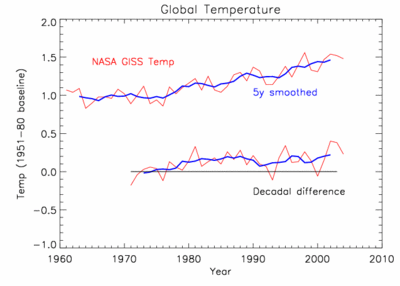 Here I've plotted the NASA GISTEMP annual temperature anomalies, and a 5-year smoothed version (both offset by 1C). The decadal temperature changes are shown below that, with the zero line indicated. As you can see, there have been two occasions in recent decades (three if you go back as far as 1976-1966) when the 10-year change has been briefly negative even during a period which has seen strong warming. William Connolley gets a similar result using a different data set. So Motl's 8:1 offer is roughly a fair bet even under conditions of continued strong warming - hardly a sceptical viewpoint. With a 5-year smoothing filter, the cooling peaks are eliminated, but he wasn't prepared to negotiate on such a bet.
An analytical look at the data gives a similar result. The annual temperatures have a variability of about 0.09C about the trend, which means that a straight decadal difference has a variability of 1.41*0.09C = 0.13C. The trend itself is about 0.17C, which implies that under the assumption of continued warming, the overall decadal temperature change is (roughly) a sample from the Gaussian distribution N(0.17,0.13) which has a 10% chance of being negative. Smoothing substantially reduces the variability - under the (perhaps slightly questionable) assumption that the temperature anomalies of consecutive years are independent, the distribution would be close to N(0.17,0.06) which has less than 1% chance of being negative.
So, no new bets yet. But both Brian and William have now offered significantly better odds than I had to, in the hope that this might tempt some of the sceptics who merely claim that future temperature change is no more likely to be up than down, as opposed to my opponents (and Piers Corbyn) who confidently predicted that cooling was imminent. William has offered 7:3 for an unsmoothed decadal difference. Brian has offered 2:1 on decadal bet, and 3:1 over 20 years. Until and unless they find any opponents, it seems reasonable to conclude that whatever the market rate is, it is higher than those offers on the table.
Most of the chasing has been done by William Connolley and Brian Schmidt. In the aftermath of my bet being announced, various pundits boldly claimed that they would be willing to take the "cold" side of a bet on the same terms or similar. Chris Randles quickly took one of them on for 500 pounds, which I reported here. However, subsequent attempts to chase down the others have so far proved fruitless.
Brian Schmidt tried here, with no response so far.
William Connolley has tried to get something out of "I'm happy to bet loads of money" Piers Corbyn, but nothing's been arranged yet. He's also emailed Tim Haab and I wait to see what, if anything, transpires.
Lubos Motl made a rather childish offer that he would accept odds of 8:1 in his favour on a 10 year bet, but only so long as it used only a single year of data at each end. Of course, this makes the temperature change very noisy due to interannual variability, as you can see on the graph below:
 Here I've plotted the NASA GISTEMP annual temperature anomalies, and a 5-year smoothed version (both offset by 1C). The decadal temperature changes are shown below that, with the zero line indicated. As you can see, there have been two occasions in recent decades (three if you go back as far as 1976-1966) when the 10-year change has been briefly negative even during a period which has seen strong warming. William Connolley gets a similar result using a different data set. So Motl's 8:1 offer is roughly a fair bet even under conditions of continued strong warming - hardly a sceptical viewpoint. With a 5-year smoothing filter, the cooling peaks are eliminated, but he wasn't prepared to negotiate on such a bet.
An analytical look at the data gives a similar result. The annual temperatures have a variability of about 0.09C about the trend, which means that a straight decadal difference has a variability of 1.41*0.09C = 0.13C. The trend itself is about 0.17C, which implies that under the assumption of continued warming, the overall decadal temperature change is (roughly) a sample from the Gaussian distribution N(0.17,0.13) which has a 10% chance of being negative. Smoothing substantially reduces the variability - under the (perhaps slightly questionable) assumption that the temperature anomalies of consecutive years are independent, the distribution would be close to N(0.17,0.06) which has less than 1% chance of being negative.
So, no new bets yet. But both Brian and William have now offered significantly better odds than I had to, in the hope that this might tempt some of the sceptics who merely claim that future temperature change is no more likely to be up than down, as opposed to my opponents (and Piers Corbyn) who confidently predicted that cooling was imminent. William has offered 7:3 for an unsmoothed decadal difference. Brian has offered 2:1 on decadal bet, and 3:1 over 20 years. Until and unless they find any opponents, it seems reasonable to conclude that whatever the market rate is, it is higher than those offers on the table.
Tuesday, September 13, 2005
IPCC WG1 available
Looks like the first public draft of the WG1 report from IPCC AR4 is available for "expert review".
Subscribe to:
Posts (Atom)