Showing posts with label AGU. Show all posts

Wednesday, January 11, 2017

BlueSkiesResearch.org.uk: The AGU review 2016

We’d rather enjoyed our last trip to the AGU and had always hoped to go back some time but it’s a long and expensive trip from the UK especially without having access to JAMSTEC’s generous travel budget. Back in February, PEN had decided to propose a session at the AGU this year, and there was at least a strong hint that some financial support might be available to presenters. So we were mulling over the possibility of going back, when a few months later, both jules and I received separate invitations to present our work there in unrelated sessions. We’ve never both been invited to speak there in the same year, so this all seemed too good an opportunity to miss. We cleared our schedules (ha!) and arranged the trip, starting with a couple of months at NCAR.

My invitation was to a new session which covered betting, financial markets and insurance as it relates to climate change. At least, it was new to me, possibly something similar has been tried in the last few years. It didn’t attract enough abstracts for a full session on its own, so was amalgamated with a long-standing session on climate model evaluation and interpretation. Jules was invited to a session on (paleo)-climate sensitivity, which also got folded into a larger session on cloud feedbacks.

We also submitted a poster to the PEN session on combining paleoclimate modelling and data, which focussed on our new attempt at reconstructing the last deglaciation. Interestingly, I found a presentation I gave back in 2009 at a different meeting proposing this idea (and an acronym – 21kaRP), but we had too many other things on our plates at that time and didn’t pursue it further. It is much more timely now that PMIP is pursuing a coordinated experiment aimed at simulating this interval with state of the art GCMs.


from window of Westin

As well as booking our favourite hotel (surprisingly good value through the AGU site, especially with two people to share the room costs) we spent a bit of time surfing tripadvisor for the best places to eat, which threw up a number of old favourites and a handful of new places to try. As a result of our research we didn’t bother with lunch on the flight but instead headed straight to House of Nanking for sesame chicken after landing on Sunday afternoon, before heading off to registration to avoid the Monday morning queues.

We didn’t find the schedule to be completely packed with must-see stuff, but there was enough to keep us interested most of the time. It’s not really sustainable attending lectures non-stop from 8am to 6pm anyway, though the remnants of a bad cold meant we didn’t have much energy for enjoying SF’s sights and shops. We had a few meetings arranged to do outside of the AGU conference itself, which kept us busy in some of the quiet times and made the whole week that much more worthwhile.

Monday was a particularly thin day, so instead of attending lectures we focussed our attention on discussing some joint work with others for most of the afternoon and on to dinner. Tuesday was mostly data assimilation. I find it interesting to see people still pushing the boundaries of what is possible with ensembles and particle methods. One interesting question is how and why the particle filter and even ensemble Kalman filter can work so well, when they should both basically fail for the modest ensemble sizes which are practically achievable. There seems to be some debate as to how these results are best interpreted…

Wednesday was a busy day for me, with a poster first thing and then a talk later. Our poster on the deglaciation is here or perhaps here if the AGU site changes
jda_agu

Unusually, the poster session was particularly well-attended and useful. I think this was a fluke of scheduling, as there wasn’t much of a clash with anything except with Bette’s Emiliani Lecture at 11:20am. So basically everyone who was interested in paleoclimate went to the posters around coffee time and stayed for an hour or so, before heading off to the lecture which was great.

It’s available though the AGU on demand streaming service, which doesn’t seem to have as much as in previous years, or perhaps I’m misremembering that. Anyway, several of the major lectures are available (the Schneider lecture by Battisti was another one that we attended), though not many of the normal short-talk sessions.

My talk (here as pdf) was late in the afternoon. Being shoehorned into someone else’s session gave me some justification, I thought, in going beyond the narrow remit of my submitted abstract to talk a bit more generally about betting and betting markets. So I enjoyed a brief meander through a subset of the betting stories that have popped up in recent years. The AGU has gone widescreen (maybe years ago, but this is the first time we’ve bothered formatting for it) which is all very well but there was at least one room where a bit more attention could have been paid to ensuring that the image didn’t extend beyond the white screen, clipping off figure captions and titles. We made sure our text wasn’t too close to the edges and it wasn’t a problem for us.
usa-15
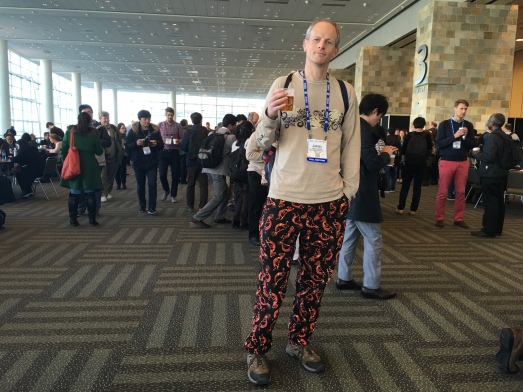
A celebratory beer

On Thursday, jules (to whom I had, just in time, successfully passed my cold) gave her talk, which had also been agglomerated into a larger session. This was a repeat of the Pliomip sensitivity paper, nothing that exciting to those of us who knew about this work though a good chance to talk about it with a new audience who mostly knew about cloud feedbacks and modern data and had relatively little exposure to paleoclimate. It actually clashed with a rather similar talk in a different session which I went to instead, so I can’t tell you how great it was🙂 For lunch we penetrated the AGU editors’ lounge which serves much larger lunches than the EGU equivalent. The pretext for this free lunch was to discuss using paleoclimate to estimate climate sensitivity with some colleagues at least one of whom is, we hope, an AGU editor of some sort. We finished off the day with a dinner at Scala’s anyway, where I had a very good ribeye steak.

By Friday we were a bit tired, and there was nothing that great on. We went to learn a bit about renewable energy which was quite fun, but it petered out towards the end. Didn’t have energy to go out for dinner so Pearl’s deluxe burgers had the honour of a second visit in the week. We also had plans for Saturday morning so weren’t really on for a late night.
usa-14

A few years ago we entered the AGU fun run and were caught in a downpour, which wasn’t actually all that much fun. Plus, the 7am Wednesday start time made it impossible to get back in time for the early session and we were particularly busy on Wednesday this year including the poster presentation first thing. Therefore we decided not to do it this time. I had however spotted that there was now a parkrun on Saturday mornings at Crissy Field (one of only a handful in the USA). So we booked an afternoon flight back to Denver, and planned to take part in this, at least provisionally depending on the weather and how we felt after a week of AGUing. As it turned out, after a fairly wet and drab week for the conference, Saturday morning dawned sunny and perfect, so we greatly enjoyed a quick trot up and down the shore with great views of the Golden Gate Bridge and all the rest of it.

20161217-2016-12-17-09-03-28

By chance it was the 100th running of the event, so there was perhaps a larger than average turnout and even cake at the finish. So that was quite a treat to end the trip with. The return flight was then heavily delayed due to another snow storm in Denver, and when we finally got to Boulder we had to trudge back home from the bus stop late at night through several inches of snow with temperatures of -20C which was a bit of a shock to the system. I don’t think I would much like to live in Boulder long-term, it’s a struggle to go outside in those conditions though I suppose some must enjoy the skiing.

Next year the AGU will be in New Orleans, then Washington DC the year after, while the Moscone Centre is being renovated in some way. Doubt we’ll be at either of them, but you never know.

Monday, August 01, 2016

Climate betting in the news again

Heard recently that Chris Hope eventually collected on his warming bet. Sounds like one of his protagonists had been dragging his heels, so that's great news. He'd already paid me my share out of the first part of his winnings. Chris wrote about it here a few days ago.

Nice article by Dana Nuccitelli in the Guardian today too:

And as it mentions, there's a session at the AGU Fall Meeting on closely related issues, which I've been invited to talk at. Will be good to see SF in December again, not been for a few years now. Probably 2012 was the last time. I'm also planning to submit something to this paleo session organised by PEN, not quite finished the abstract yet.

Monday, May 16, 2016

Open review vs open access.

Now that Boris Johnson has finally Godwinated the EU referendum debate I don't need to discuss that, and can talk about this instead. Though actually, it's about at the same intellectual level as Johnson's comments. Everyone agrees it's junk, the questions are why this stuff gets written, and how it gets published. I won't speculate here on the why (I already did here), just the how.

It has appeared in a new journal of unknown quality, the AGU (partnering with Wiley) seemingly jumping on the open access pay-to-publish bandwagon. It is worth noting, Bates has not previously published there, he didn't choose it out of familiarity or convenience, but had (apparently) been shopping around since at least 2014 with this idea trying to find a home. Pretty much everything gets published eventually, by the way. It just takes longer if it's either rubbish, or a revolutionary idea that is well ahead of its time.

It's a shame Bates didn't have the guts to try ACP or ESD, where his manuscript would have been shredded by reviewers in short order. It is all too easy for a lazy or overstretched editor at any journal to simply use the author's “suggested reviewers” without also looking for an independent view. At least in the case of the EGU open review process, an incompetent reviewing process is in principle discouraged by the fact that it's out in the open, and there is of course the opportunity for other interested parties to add their views. Score +1 for open review.

Sunday, December 16, 2012

The AGU review 2012

Sorry for the delay, but I was too busy having fun at the AGU to blog about it. For some reason, we had no real jet lag at all on our trip, either while over there or following our return to Japan. I don't really have much of a clue why it sometimes works out like that, but it's nice when it does. Also, we've really sorted out the food situation in SF. There are lots of good sandwich shops for lunch, which is a much better option than trying to fight your way in and out of the overcrowded restaurants during the lunch break. Of course the huge range of restaurants is good for dinner, even though one unexpected side-effect of discovering possibly the best pizza in Tokyo is that the best pizza in SF is not so special any more. San Francisco is a good city for a huge conference like the AGU. The weather was mostly nice this year, apart from the fun run which happened to be scheduled just perfectly for the few hours in the week when it absolutely tipped down.

The scientific program seemed better than usual, too. First day, I started off with some last millennium stuff. The convenors had generously invited me to talk about this work, but I thought it would be appropriate to decline on the grounds that I hadn't done anything new since I talked about it at a very similar session (albeit with different convenors) the previous year! There was actually someone doing rather similar data-assimilation-y things, which was interesting. I'm not sure if and when I'll have time to work on this again. I think jules was learning about ice sheets at the same time.

I had a walk round the posters after lunch. This is still a bit of a disaster area as far as I'm concerned. The "author in attendance" period is supposed to be a self-selected hour within a 4h:20 time window, so it's almost impossible to meet anyone without prior arrangement. At the similarly vast (well, half as big) annual EGU meeting, there is a 90 minute early evening slot where - at least within the Climate division - there are no oral presentations scheduled at all, so all the poster authors are present together and it's an excellent opportunity for (wine-enhanced) discussion and mixing.

Last session on Monday was on atmospheric feedbacks, which in practice included climate sensitivity stuff. There was a rather silly presentation on "changing climate sensitivity" which IMO just pointed to the inappropriateness of trying to analyse all historical climate changes as if they were a response to an imposed CO2 forcing, which of course they were not. The atmos feedbacks continued into the following morning, after which I went to the "communicating climate science" session. That was the expected knockabout stuff, though unfortunately Dan Kahan (who would probably have had the most scholarly perspective) withdrew. Naomi Oreskes talked about her theory of "erring on the side of least drama" which I didn't find completely convincing. Now I've seen the paper, her analyses of scientific underestimation seem rather less compelling than she made it sound in the talk. I should come back to this in a later post. Jules tried to get into the Charney Lecture, but the room was too full. However, it is available on-line. I left a bit early in the afternoon, as we had an important dinner date with some lobster, quail, lamb, steak and cheese. There may be Tokyo restaurants to match Gary Danko, but not at that price.

Wednesday morning was the not-so-much-fun run. Actually, it wasn't that bad running in the rain for once - but I suspect the novelty would quickly wear off - and least it wasn't all that cold. Drying off back at the hotel caused us to miss the start of the two morning Uncertainty Quantification sessions, which was a bit of a shame as this had several interesting-looking talks and is not available on video. After lunch I went to Stephan Lewandowsky's "Construing Uncertainty" which was more social than hard science, including Oreskes again. Then jules was talking in the last UQ session, on the use of paleoclimate simulations for testing and validating models. Lenny Smith also gave a very good and thought-provoking talk as always. This meant I missed the Lorenz lecture, given by Eugenia Kalnay, but I knew it was being videoed, and have watched it subsequently. I highly recommend it to anyone interested in the theory and practice of how prediction is done in highly complex and nonlinear systems such as weather forecasting. (The preceding lecture included in the same video may not be so widely interesting.)

Charles Jackson also talked in one of the UQ sessions, and that night we went out to dinner with him (and two Japanese colleagues) afterwards at the Thirsty Bear. Once the shouty early-evening crowd have moved on, it's a surprisingly civilised place for good pub grub.

Thursday morning was a bit thin in the program, and I believe we might have had a bit of a lie-in after the night before :-) The afternoon had a big paleoclimate session, with several people each talking about their own latest core and its interpretation (or so it seemed to me), and some broader syntheses including my presentation on the Last Glacial Maximum. I will also blog about this in more detail, after doing what I hope will be some final revision to the paper.

After a fairly packed week, (and contrary to the previous year) Friday was almost a complete blank. Or at least it would have been, had Lewandowsky et al not conveniently arranged an off-site discussion meeting which followed up on their "construing uncertainty" session. I'm always a bit dubious of these talking shops, and I'm not sure exactly how much real progress was made, but it was surprisingly fun and interesting, and it was good to have the chance to discuss and expand on ideas in a much more flexible and informal format than the tightly scheduled AGU sessions. Attendees included a large number of the usual blogging suspects (Rabett, Nielsen-Gammon, Sceptical Science, Easterbrook, Baer, and probably one or two more I've forgotten), though Michael Tobis was a surprising absentee. One point of interest was the broad consensus among the climate scientists present that things like Hurricane Sandy and other extreme events were not the most sound basis for convincing people about the reality and/or impact of climate change. Although it's plausible that many extremes will get more extreme, the evidence (both theoretical and observational) for many specific examples (such as, changes in the frequency and size of storms hitting NY) is not really that solid yet.

It was noticeable how much quieter the main conference centre was by the time we returned to it after lunch. Not many of the participants stay to the bitter end. We spent the afternoon in a cryosphere session. I suppose it is well-known within the field, but it was interesting to see to what extent the ice sheets vary even within the supposedly "quasi-equilibrium" state of the Last Glacial Maximum. I doubt it has major effects on broad scales, but certainly helps explain how some people can find historical evidence of vegetation in locations where the models have big fat ice sheets :-) (This issue only arises close to the the edge of the big fat ice sheets, to be fair.)

And this year, after the weekend of travel back home, we did make it back in time for the carols in Yokohama, followed with some mince pies that I made earlier.

There's a lot of good stuff available as video on demand. We are slowly working through it in idle moments. Maybe it's not quite as good as being there, but it's a lot cheaper and involves a lot fewer air miles. Jules' plan of world domination through the VGU (Virtual...) is getting closer year by year.

Sunday, December 11, 2011

AGU 2011 aftermath

The previous post was actually written during the break before Gavin's session on the CMIP5 models, which turned out to be one of the better ones. Mind you, the analyses were substantially less thorough than most authors had promised/intended when they wrote their abstracts, due to limited data availability. For what it's worth, the executive summary is that the CMIP5 model projections seem to be broadly similar to CMIP3 so far. I would not be surprised if the IPCC deadlines slipped a bit, like they did last time. In fact they have already slipped compared to the timetable that was originally proposed, but for some time now the deadline for submitted manuscripts (to be citable in the report) has been July next year. To date there are very few paleo-related runs on the database (6 mid-Holocene, 1 LGM and 2 last millennium last time I checked) which makes it hard to see how this facet of the project can be included at all in the WCRP CMIP5 workshop in Hawaii in March - the deadline for abstract submission is this week, and: "To demonstrate that your analysis has already begun, you are encouraged to include a description of your preliminary analysis so far". Will be interesting to see how that pans out...

Anyway, Gavin's speakers made a good effort to be energetic and interesting, and jules said the parallel session on paleo modelling was also good. Friday afternoon last year was also one of the highlights. After, we went out to dinner with the Bristol bunch, and had 15 different types of meat grilled in Brazilian style. It was a fun but rather late night after a long week. Overall, we had a rather better time than last year, and my cold and sore throat waited until we had returned before coming on. I'm actually quite looking forward to white rice and miso, for a day or two at least.

Sadly our flight home was delayed, so we missed our annual Christmas carol service that we were expecting to get back for. It's the first time we have been significantly late at Narita for as long as we can remember.

Friday, December 09, 2011

AGU day 4 and 5

After a rather late return from Gary Danko we didn't have the enthusiasm for a morning run on a cloudy day, so just staggered in for some talks on data assimilation to hear about the latest new ideas. jules went to ocean acidification, which is perhaps of more general interest. Another working lunch followed - despite jules' cynicism, this year has been significantly enhanced by the number of people we've managed to meet. Last year we were a bit ill and knackered so it wasn't as productive. In the afternoon there was another session on the last millennium, in fact my talk might have fitted in a little better there than on Wednesday's session which was more generally covering paleo-for-future-predictions, but there was a strong overlap in terms of attendees and interests. Flagging a little after the previous splurge, we waddled off to the local Thai for a quick and early dinner - I'm not sure if it is really worth two meals there (and for the 2nd year running!) when SF has so much more to offer but it was just what we felt like.

This morning we managed a run and an 8am start - breakfast was the missing element, but eating is getting increasingly difficult. First session was interesting stuff on climate variability, with various wiggles in both models and data, some of which occasionally coincided to some extent. Lunch we managed to follow Eli's recommendation for Yank Sing which was definitely a cut above (jules said 3 cuts, in fact) the local place we have previously visited. As with last year, the organisers have kept some of the best till last, which may be a bit of a shame when so many leave early. There are sessions both on model-data comparisons, mostly modern data sets but also including jules's talk on paleo data, and also some more paleo modelling. Nothing outstanding, but it's useful to keep up with what is happening. I think the "new" obs4mips data sets are going to be particularly useful, as they are being designed to be readily usable even by numpties such as myself.

Thursday, December 08, 2011

AGU 2011 Days 2 and 3

As we already hinted, Day 2 was a bit of a washout for us. I wonder if the low density of interesting sessions is something to do with the division split with "Global Environmental Change" being perhaps the closest approximation to EGU's "Climate, Past, Present and Future", but the latter includes paleo whereas the AGU has that split into another division. Anyway, the morning jog to the Chestnut bakery was fun. For dinner, we slummed it and just used the hotel cafe aka "Bourbon Steak", where we shared a $28 - 70oz T-bone. Last year I'm sure it was only 69oz, so I suppose that's inflation for you. However, the exchange rate has changed so much that on converting to metric, it was actually rather smaller than last year. Or something like that.

Wednesday had an interesting session in the morning on earth system sensitivity and paleoclimate. Various somewhat incompatible definitions were used which makes direct comparison different. Most people seem to agree that longer-term feedbacks will increase the overall effect when compared to the classical AOGCM-based definition. Some people were looking mostly at data, others at models. One person concluded that the models were all wrong based on a single tropical core that differed substantially from the major MARGO data set - I pointed out in the Qs after that singling out the models for criticism in this situation seemed a little unfair! The session finished off with Jim Hansen who of course got a good reception. I thought his jibe at Andreas Schmittner (about how he had included dust aerosols as a forcing rather than a feedback) was a bit ungallant. The main point there AIUI was that he included the effect at all, when most GCM-based simulations of the LGM did not. Andreas did have the opportunity to defend himself at the end though.

A group of ensembles-and-uncertainty people had a chat over lunch (arranged by Ben), and it was interesting to hear how they were all getting on in a rather more relaxed format than via rapid-fire 12 minute talks. I had to rush off rather for another session where I was first presenter. This is on some still-unfinished (but I'm getting there!) work on last millennium reconstructions. From the audience perspective, jules thought it was more relaxed and better than Monday's effort where I tried to summarise 5 papers in the same time frame. Maybe there is a lesson there... Other talks included Andreas Schmittner presenting his recent paper. He seemed to have taken on board at least some of the criticism that has been put forward and he sounded rather more in tune with Nathan Urban's interview here, than in the press coverage here, for example (especially regarding the "robustness" of the result).

As for dinner, Gary Danko really is worth the hype (and the hoops that have to be jumped though to get a table). Eating good restaurant food here does bring home just how good the seafood that my Dad sometimes searches out is, however.

I think I have forgotten what it feels like to be hungry. Again.

Tuesday, December 06, 2011

AGU 2011 Day 1

SF is reputed to be drizzly and cloudy much of the time, but unlike last year the weather here has been fabulous so far and is set fair for the rest of the week. We arrived on Saturday morning after a good flight and had a great couple of days over the weekend, On Saturday we visited the TCHO chocolate factory on the Embarcadero (that was jules' special request, naturally) and returned home via an early Chinese dinner - the House of Nanking gets mixed reviews, I expect there is better/cheaper food for those with energy and knowledge but it certainly fit the bill for us at that time. Sunday morning started with a jog to the Embarcadero, along and back over the hills of Powell and Hyde. We then got a bus over to the Cliff House for brunch and a walk on the beach, before meeting Rob who took us to one of his old favourite spots for dinner.

Oh yes, and now we get to the reason excuse we had used to come here. Monday morning started with poster-viewing, so we had a late breakfast in the Blue Bottle cafe on the way. Then the posters themselves, including those associated with the afternoon talks we were planning to attend, which were quite fun, and I got to meet a few new people. Harry Elderfield's medal lecture was a reasonably interesting history lesson on the (mis)understanding of proxies, and then we had a useful working lunch with Dan talking about some collaboration. I was talking in the uncertainty session straight after lunch. I just about managed to rattle through a review of the work we have done with the CMIP3 ensemble, including the most recent GRL paper (now officially in press), without being able to go into much detail about any of it. The rest of the session was the usual sort of mixture, some old or incomplete stuff (promises to evaluate CMIP5 have mostly been honoured in the breach) but also some new. The philosophy session followed after tea beer. It is interesting and I think probably useful to hear people placing scientific work on model evaluation in some broader context, but these people seem to be mostly following rather than leading or inspiring the process, and doing so from a bit of a distance. For example, some of the audience pointed out that as well as the open CMIP3 archive, there is a huge amount of evaluation within the centres themselves that doesn't necessarily get reported in the literature. I also thought there was a bit of a logical failure regarding the vexed question of the "independence" of the models, but there didn't seem to be much point in picking a fight so I kept my mouth shut. [While considering the confirmatory effect of multiple models, several speakers stated confidently that the IPCC ensemble of models were not "independent", while openly admitting that they were utterly incapable of providing any operational or measurable definition of this property.] Apart from the wifi limitations, it was a good start to the week and the Thai restaurant that we discovered last year now seems deservedly more popular and perhaps even better food-wise than I had remembered. I'll note the "Angel Wings" starter for future reference.

Law of unintended consequences

One nice side-effect of our recent running habit is the ability (or perhaps willingness) to jog along the Embarcadero on a sunny morning to the excellent Chestnut Street bakery for breakfast.


Today is a bit of a thin day for both of us content-wise, and we've learnt from bitter experience that attempting 5 full 10h days is not really sustainable, so we took the opportunity for a leisurely start to the day. Amazingly after the disaster that was Denver, we've not had any jetlag problems at all this time, just 3 good nights of sleep. Oh, and a lovely Chinese dinner, German-style pork chop, Thai dinner, and assorted snacks and breakfasts. We even found decent coffee for the first time in three trips (a recommendation from Rob who used to live here).

Sunday, December 19, 2010

AGU part 2

On with the show!

Perhaps it's best to blog a little after the event, as it gives time for the boring and disappointing bits to fade away, leaving a more positive overall impression. And with an 11h flight I have ample time to wax lyrical about the good bits too, rather than struggling to scribble something down in a spare moment. Indeed I now see on checking through my notes that there were a couple of interesting talks on Tuesday, that I didn't mention before, in the section on uncertainty quantification. First Carol Snyder presented an unusually high estimate of climate sensitivity based on paleo data, which appears to hinge on a strong estimated LGM cooling. Not that this makes her wrong of course, but the previous week, Andreas Schmittner had presented a somewhat contrary result at the PMIP meeting, so I will email them to try to identify the discrepancy. Derek Lemoine also presented some evidence, probably compatible with Frank et al (who spoke in the morning), supporting a lowish (but positive) carbon cycle feedback at the bottom end of the model range. Jules went to a session on geoengineering where everyone seems to be trying to prove that even if we could restrain the rise in global mean temperature, it was only by screwing up all regional patterns of rainfall.

Wednesday

On Wednesday morning I started off at writers corner, where several authors of popular science books discussed their work and/or their lives. And then at the end of this session we had Greg Craven. It tended rather to the hysterical, and I don't mean that in a good way. My complete unabridged notes on his presentation read "I am insane. Apocalpyse soon." although in the interests of fairness I should point out that only the first sentence was a direct quote, the second was merely my personal summary of events. Perhaps the most I should say is that since Stephen Mosher wrote in detail about how much he didn't like the panel discussion later that day, I can only assume that he did not attend the prior presentations. I actually walked out of the panel discussion at the point that Greg started telling an uppity woman (president of some equal opportunities organisation, no less) that she had said her piece and could she please shut up and sit down. Pot, meet kettle. Oppenheimer, on the other hand, gave a sensible talk that I found interesting, if not too earth-shattering. He argued that scientists have a general duty to engage with the public, and even if we didn't want to do it individually, we can't necessarily avoid it in a world where merely being a climate scientist puts us in the firing line. However, under the rubric of "engaging" he discussed a wide range of options, and I was amused to see him list blogging as ranking higher than merely participating in assessments such as the IPCC and NAS :-) He also emphasised the importance of only speaking in areas where you had earnt credibility based on your published record, which formed an interesting backdrop to Judith Curry's talk later that day. She devoted her time to accusing the IPCC of ignoring the tails of the pdfs of climate sensitivity that were clearly presented in the very figure that she repeatedly referred to and explicitly emphasised in the summary ("values substantially higher than 4.5C cannot be excluded"), then read out a few cartoons and finally, literally out of nowhere, concluded that therefore they had underestimated the magnitude of decadal variability and that their detection and attribution results were unsound! Really, I'm not making this up, it was actually how it happened. These latter topics were first introduced on her concluding slide and there was no hint of supporting argument. She also talked about the "modal falsification" of Betz 2009, (which I haven't read but just googled now, is there a free version somewhere?) so I asked if and how this "falsification" (and she used the scare quotes herself) was distinct from assigning a low posterior probability in a Bayesian sense. She replied that it could be considered the same, at which point some of the audience were shaking their heads and others were nodding in agreement. From which I conclude that nobody, including Judith, knows what Judith means. Unfortunately, she didn't seem to be anywhere to be found at the end of the session and I didn't see her at any of the other relevant sessions where people actually dealing with these sorts of issues were actually presenting concrete results.

Thursday

There was more communication stuff on Thursday morning, much along the lines of wailing about how nasty everyone (well, Republicans and/or denialists, at least) was being to climate scientists, and how we need to educate everyone about the Truth of climate change. Which of course is true to some extent, but I'm not really convinced it is worth the time and energy that was devoted to it at the AGU. Tim Palmer gave a really good Bjerknes Lecture, which I nearly didn't go to as I've seen most of the content before (at the INI) but I'm glad I did as it seemed much better this time round. Of course, as he mentioned, it was a sort of anti-Bjerknes lecture in some ways, because the eponymous scientist was firmly rooted in the deterministic world and Tim is very much in the probabilistic/ensemble forecasting mould (as everyone in NWP has to be, of course, and I'm sure Bjerknes would agree were he around today). In fact Tim is a strong and convincing advocate of the use of stochastic parameterisations in climate models, which formed the main content of his talk. I agree they are a good idea and must remember to mention some time that Jim Hansen used a random number generator in the cloud scheme of his 1984 model :-) One of the numerous modelling groups here is using a more modern equivalent, so I don't think it's something that people are particularly hostile to. Where I part company with Tim is in his advocacy of a single coordinated model-building effort, which to be fair he hardly mentioned this time. I think it is clear that even with stochastic physics, we would still need a range of different models to investigate our uncertainty in long-term climate change meaningfully, and Suki Manabe made exactly this point in his inimitable style in the questions after the talk.

After lunch there was even more on communication. I'm not sure if it was deliberate or not, but the session discussing how to cope with this blogospheric "other" that scientists don't really understand was running in parallel with a panel of science bloggers offering advice to those who were prepared to join in. I only stayed for a little of the latter, it was pretty anodyne stuff. As jules noted, they all seemed to be "normal" geoscientists, none of them were involved in the post-normal world of climate science so their take on questions of debate, argument and abuse seemed somewhat rose-tinted to me. Not that that should put anyone off who is considering getting involved. I also thought their attitude towards discussing on-going and unpublished work was rather 20th century.

Then it was time for us to head off to defend our posters, which we had planned for beer o'clock to ease the pain. Unlike the EGU where the poster session was arranged every evening, here the poster session was scheduled for a full half-day (4h20m) out of which you were supposed to pick at least an hour that you would be there. Of course this is horribly inefficient and made it very hard to meet specific people, though perhaps there were enough random encounters that it didn't matter and a good poster should be pretty self-explanatory anyway. I didn't have that many visitors but made up for that by having long chats with several of them.

Friday

Friday was probably the most fun, with lots of sessions on using data together with models. First the reanalysis session, where various improvements and new analyses were presented. There are still lots of problems with inhomogeneities in observations which make the trends in precipitation extremely dubious - even at the global average scale, different analyses gave substantially different results. Jules heard about various attempts at carbon sequestration, but it wasn't clear if they would be practical and effective. Then in the afternoon there was a big session on using observations to test and validate models, which is of course right up our street. There is a big push for more of this in the context of the CMIP5 model runs, and it seems there will be some basket of comparisons proposed although it must be remembered that no-one actually knows what particular features are important in improving model predictions. As well as a number of fairly detailed and specific studies Wendy Parker spoke about the broader context of how we could think about model adequacy and performance. There had already been a whole session on more philosophical aspects of model interpretation which I did not attend but jules did, I think many people are generally aware of the issues, but struggling to find concrete solution. Anyway, I didn't think that anyone presented anything particularly earth-shattering in this session but unlike some of the other more disappointing parts earlier in the week, they were at least presenting some new ideas and results, rather than either merely re-reading an old long-published paper I already knew about (which are few had done) or else talking vaguely about what they were hoping to do in the next few years. I also stuck my oar in with a few questions and comments, which at least made it interesting to me :-) I also have a few more things to chase up with some of the speakers via emails as I didn't quite understand what they had done, or perhaps why they had done it.

So in the end I suppose the whole thing was quite fun and I'm certainly happier on the plane on the way home than I was a few days ago when I wrote the previous post. Given that we were tired before we even started (following on directly from the PMIP meeting in Kyoto last week) and that jules came down with a cold that hung around all week, we are glad to be heading home. In fact our devotion to duty is such that we turned down the offer of $800 each to get bumped off the plane which was over-booked. Maybe we should have taken the money and gone straight back to the Mac store but we are sufficiently worn out that another day of sightseeing in SF (especially given the rain) didn't really appeal. Jamstec would also have had a fit of course, which almost tipped the balance in favour of staying, but not quite. And anyway, they've already bought us everything that the Mac store sells :-)

Saturday, December 18, 2010

AGU aftermath

I know, I haven't actually blogged much of the content yet. I will try to work through my notes on the flight. Which thankfully we have managed to check in to on-line, jules having eventually guessed that the seats were booked in the name of Annan, Jamesdouglas and Hargreaves, Juliacatherine. These are not, needless to say, either the names in our passports or those that we were christened with! The joys of Japanese confusion over naming conventions never ceases to amuse... As a result of this, on the way out we were both unpleasantly stuck in centre-block seats in different rows, this time we should be together at the exit row with a bit of leg room. That's assuming we get though the security groping unscathed. Usually we are treated with extra suspicion, presumably due to perfectly fitting the profile of international tourists with weapons of maths instruction. No, I'm not going to make any such jokes at the airport.


Most of the reason for writing this is as a reminder to myself for next time, that there is an alternative at the Thirsty Bear to standing in the crowded bar area shouting at/with drunk scientists and failing to get served at the bar. I realise this makes me sound like an old fuddy-duddy (as does using the term "fuddy-duddy") but Americans are REALLY LOUD. No, I mean REALLY REALLY LOUD. DANGEROUSLY, INDUSTRIAL-STRENGTH LOUD. ESPECIALLY IN BARS. ARE YOUR EARS HURTING YET?

Now where was I? Oh yes, I must also remember for next time that the best of their beers is probably the plain old Brown Bear (jules liked the stout too). The more exotic things don't always come off quite as well, and some are a bit too strong to be quaffable in the British style. It's all better than the stuff we had elsewhere though, including the inexplicably popular Anchor Steam and some other IPA which, like last time, reminded us of rather amateurish homebrew. Oh, and the beer service at the posters starts at 3:30 and ends shortly thereafter when it runs out, so get there sharp. That's also only Anchor Steam, but it's free...

As for the conference, well it had its moments, though perhaps a few fewer than we might have hoped for during such a large affair. I got to meet a handful of new people which was useful and interesting, and re-meet a few others, which is always worth doing. But to be honest, I wasn't here so much for the science as to spend some budget as quickly and easily as possible (and hopefully at least with some benefits), and it was a roaring success on that front. I know that will probably outrage some people in these times of straitened circumstances, but bear in mind that this is only Japanese money. In fact it's not even Japanese taxpayers' money really, just stuff the Govt prints and makes us spend to keep the economy afloat. If we didn't spend it, the whole house of cards might fall down.

Now just one Eggs Benedict to force down before we head off to the airport...

Thursday, December 16, 2010

More AGU

OK, here are some highlights and lowlights from the first two days...

On Monday lunchtime, John Holdren gave a party political broadcast for the Democrat Party. "Never before has a President spoken so much..." I was waiting for "...to so little effect" but in fact the continuation was "...about Science and Technology". To be fair, he did acknowledge that talk wasn't actually that useful in itself, and also gave a laundry list of how everything is getting better under Obama. Which may even be true, I don't presume to judge. Later that day Julia Slingo in her "Frontiers of Geophysics" lecture gave some insight into the direction the UKMO was taking towards hazard prediction, mostly on weather-related time scales of course.

Of course a fair proportion of the posters are pretty pointless, due to people having to submit one to justify the trip. Can't blame them for that, but it does make it hard to find the handful of interesting ones. Steve Schwartz was trying to pretend that all the CO2 will simply vanish into the ocean in a few decades if we stop emitting, but there was someone already there debunking him as I passed by. The talks are a mixed bag and seem a pretty incestuous affair. Particular raspberries are due to the organisers responsible for offering Gardar Johannesson an invited talk to present LLNL's vague plans and tentative initial steps towards investigating parametric uncertainty in a single GCM - there was little hint towards the uncomfortable fact that they are about 5 years behind several other groups around the world in this respect - in fact, as well as the Hadley Centre and CPDN work with HadCM3, and us in Japan with MIROC, there are even two groups already doing this sort of thing with the very same model in the USA (Ben Sanderson at NCAR, Charles Jackson at U. Texas)! I'm sure it is no coincidence that one of the organisers of that session was from the same lab. On top of that, Nychka and Sain spun out a single piece of collaborative work into two invited talks in adjacent co-sponsored sessions. While I was listening to a sequence of talks that leant heavily on the truth-centred paradigm for the interpretation of climate models (ugh), Jules went to a session pointing toward policy relevance of climate science which seemed to be largely based on Roe and Baker's pdf for climate sensitivity (sigh). Well, I suppose it gives us plenty to do over the next few years, but the lack of progress or penetration of new ideas is a bit depressing to witness. On a more positive note, Steve Easterbrook gave an interesting overview of his anthropological investigations into the software engineering practices of several climate research labs (see his blog for more). I suspect RIGC may be a little less well organised than the places he visited, but hopefully not too far behind. So far, I think the dinner at Slanted Door has been the highlight (especially the rack of lamb), but there is more to come...

Tuesday, December 14, 2010

Blogging the AGU

Have had a passable (cheap) burrito, a pretty decent Thai dinner, brunch at Dottie's True Blue Cafe (perhaps surprisingly, it really was worth the wait) and a 28oz steak.


OK, I shared the steak, and that list covers both Saturday and Sunday's meals. We also took a tram ride, walked up Vallejo and down Lombard Street and have done a lot of shoe shopping. Both jules and I fall outside the normal size range in Japan, which made that a particular priority here.

I heard there was some sort of conference about to start. Hope it doesn't spoil our holiday. Still got a few more meals to fit in somehow.

SF is fun, but I have to make two complaints. First, coffee in the USA is awful. Weak but somehow also nasty-tasting swill. Yes, I'm sure there are some places to get a decent brew, but a large proportion of what we've had so far has been pretty horrid. I can only imagine that Americans actually like it like that. And secondly, the amount of smoke on the streets is obnoxious. Can't you introduce some Japanese-style laws and make the smokers all lock themselves into smoking rooms where they can all share the love with each other rather than inflicting their habit on normal people? (I know Japan hasn't fully sorted out the restaurant situation yet though, and Kyoto seems worse than Tokyo/Kamakura).