Tuesday, February 28, 2006

Police left red-faced after arresting Japanese woman they thought was a foreigner - MSN-Mainichi Daily News

This is an amazing bit of news: Police left red-faced after arresting Japanese woman they thought was a foreigner:

At around 7:40 p.m. on Saturday, three officers spoke to a 28-year-old woman walking on a street in Kawaguchi, and asked her name and nationality because she looked like a woman from Southeast Asia, according to the officials.

After saying, "I'm Japanese," she refused to talk to the officers, who took her to the police station. After she refused to respond to the questions officers asked her in Japanese, police deemed that she was a foreigner.

<>They held her for 14 hours, merely for "looking Asian" (like the UK attitude to "European", some Japanese use "Asian" to mean "Asian excluding Japanese"). Of course, the idea that Japanese are visibly different from other Asians is pretty ridiculous in the first place (as this case proves), considering this to be a justification for arrest is absurd.
<>

Guardian Unlimited: Climate scientists issue dire warning

There's an interesting article by David Adam in the Grauniad today, entitled Climate scientists issue dire warning:
The Earth's temperature could rise under the impact of global warming to levels far higher than previously predicted, according to the United Nations' team of climate experts.

A draft of the next influential Intergovernmental Panel on Climate Change (IPCC) report will tell politicians that scientists are now unable to place a reliable upper limit on how quickly the atmosphere will warm as carbon dioxide levels increase.
So apparently one of the lead authors has been "leaking". However, later the article says:
According to sources who have seen it, the draft now assumes a doubling of carbon dioxide would cause a likely temperature rise of between 2 and 4.5C, but says higher increases are possible.
Peter Cox describes this as a "significant" move, but it doesn't actually sound like much of a change at all to me. The previous 1.5-4.5C range was only confident at the "likely" level, obviously implying a significant chance of a higher figure. Maybe something got a bit lost in translation, or maybe he knows of some more details not reported here. Anyway, us mere mortals will have to wait another month or so before we get to see the second draft (even though I was listed as a "contributing author" on the first draft of one of the chapters). It will be interesting to see how the lead authors attempt to reconcile the various opinions expressed in the literature.

Further on in the article, Peter Cox is quoted as making this strange statement:
"The scientific agenda has moved from improving the predictions to thinking about what are the chances of something awful happening."
and Dave Stainforth talks about the "destruction of society". I think that amply vindicates my comment about people "talking up the possibility of disaster".

Sunday, February 26, 2006

I'm Scottish!

Since coming to Japan, I've frequently been referred to as "English". It's not something I make a big fuss over, particularly as Japanese doesn't seem to have a clear distinction between British and English. Once or twice when I've tried to explicitly describe myself as Scottish, people end up drawing maps and trying to place this small country somewhere in the vicinity of Norway and Sweden, so I've pretty much given up bothering. But every so often, I feel it's worth reminding people where I come from :-)

Scotland is mostly famous for whisky, haggis, and deep-fried delicacies such as Mars bars, pizza, and the aforementioned haggis. On the sporting front we specialise in curling and elephant polo (unfortunately, this time the curlers finished 4th and 5th in Turin - the women even lost to Japan). Many famous scientists and inventors are actually Scots, including people like Alexander Graham Bell who many USAians may think of as one of their own (he emigrated and founded Bell Labs). As well as his telephone, probably all readers will have benefited from the work of John Logie Baird (TV), Watt (steam engine), Dunlop (pneumatic tyre), McAdam (tarmac roads), Kirkpatrick Macmillan (bicycle), Napier (logarithms), Fleming (penicillin), Maxwell (his equations) and others too numerous to mention.

Of course jingoistic nationalism isn't really a rationally defensible attitude. These white men all died before I was born, and I had precisely nothing to do with the Scottish rugby victory. But that won't stop me from enjoying it :-)

Saturday, February 25, 2006

No. of foreigners given refugee status hits record high

Japan granted 46 people refugees status last year, a record high. A further 97 were granted permission to stay.

The equivalent figure in the UK is generally in the region of 10,000 per year. This is not particularly exceptional compared to other European nations.

In other news, Tottori prefecture gave up on its attempt to introduce legislation protecting human rights, including outlawing racial discrimination. The reason given is that the lawyers didn't like it. Just to clarify this, they aren't merely giving up, but are actually introducing a new bill to suspend enforcement of the HR legislation. As one person here comments, they could justifiably call this new bill the "Tottori Inhuman Rights Act of 2006".

Farmers' response to bird flu

I am struck by some similarities between the approaching bird flu epidemic, and Foot and Mouth disease which hit the UK a few years ago.

At the start of the F&M outbreak, the National Farmers' Union was strongly opposed to any basic biosecurity measures such as restrictions on movement of cattle. Instead, they issued sterotypical "get orf moi laaaaaand" calls for tourists to stay away (the economic value of tourism is massively bigger than farming, and of course the disease isn't spread by tourists anyway, but it was a good chance to flex their muscles). The Govt (especially MAFF, which despite officially having responsibility for the countryside was essentially ruled by farming interests) went along with this, and imposed various fines and restrictions. The delay in cattle movement restrictions resulted in a massive national epidemic of this virulent and highly infectious disease (which fortunately has no implications for human health), and the entirely pointless shutdown of the tourist industry wasted billions of pounds.

Eventually, the Govt realised that the shutdown of the tourist industry was a massive over-reaction, but by then the damage had been done. The farmers got their compensation (ok, I'm sure that plenty of them also lost some money) but the tourism-related industries are still struggling to recover. MAFF deservedly ended up on the funeral pyre also, and its replacement DEFRA has a more explicit responsibility for Rural Affairs in general rather than the special interest of agriculture.

Now we have bird flu approaching, and what do the NFU do? In response to a suggestion that it might be sensible to keep poulty indoors, they call this a massive over-reaction. All we need is for them to do is to follow this up with exhortations for the townies to stay away, and history will have repeated itself in only 5 short years.

(If you've got some time to kill, you might enjoy this usenet thread from a few years ago - at 1134 messages, I think it's my most successful troll ever. Unlike most trolling, it was however entirely true, and was clearly vindicated within a few months.)

Thursday, February 23, 2006

Spring time

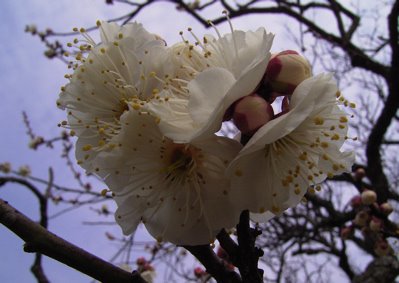
At last, it feels like spring is here. It was a warm bright day today, so we took the day off to enjoy the ume blossom. Ume is usually translated into English as "plum", but it's not really a plum as eaten in the West - in fact it is more of an apricot, and the fruit are small, hard and bitter, often eaten as a sour pickle (umeboshi).

We also heard some Japanese nightingales singing today for the first time this year. I didn't realise they were traditionally associated with ume blossom until reading the Wikipedia pages.


Apparently the Japan Meterological Agency is thinking of officially naming the recent bad weather "Heisei 18 Heavy Snow" (Heisei 18 is 2006, in the Japanese naming system - the 18th year of the current Emperor's reign). It's been the worst winter in decades. There's more snow forecast tomorrow, but warmer weather should be just around the corner.

Wednesday, February 22, 2006

Retirement age 'should reach 85'

It's interesting to see this idea getting more air-time, and also that people are starting to make more radical suggestions (the UK Govt's position is in comparison some rather feeble kite-flying which talked of about a 3 year increase in retirement age, starting some time after 2030).

As a foreign researcher in Japan, I'm compulsorily enrolled into the pensions system, which means that money is automatically removed from my salary with no realistic possibility of my ever getting a payout (I'd have to contribute for 20 years continuously, which considering it will take another 5 years of annually-renewed contracts before it would be worth even bothering to apply for permanent residency rights let alone citizenship, and there is virtually no chance of tenure here, is hardly a serious possibility at this stage). This state-sponsored theft of my salary is just one of those minor niggles that no-one is ever going to fix because (a) it would cost money and (b) there are no votes in it. Since I'm not a taxpayer in the UK, there is no incentive to contribute to a pension fund there either, although I should be able to make some of the shortfall up if and when I return - unless I'm kicked out at age 60 or sooner, which is currently the way things work in the UK research labs. If retirement age is up to 85 by 2050 then I've got plenty of time! (No, I'm not really stupid enough to think this is likely to be the case.)

Sunday, February 19, 2006

73,000,000:1

This is the famously erroneous statistic quoted by Roy Meadow, supposedly giving the odds of two children dying of SIDS (cot death) in the same family, when appearing as an "expert witness" in a murder trial. His "evidence" neatly illustrates two distinct fallacies in the same calculation, and as well as resulting in some wrongful convictions which were eventually overturned, he was struck off by the General Medical Council, but has just been reinstated following an appeal.

Firstly the fallacies: he got his number by squaring the odds of a single child dying in this way, of about 8,500:1. The implicit assumption is that such deaths strike entirely at random. However, if there are any genetic or environmental factors involved, a the probability second death in the same family would be far greater. Ignoring this factor is known as the ecological fallacy. In fact medical research suggests a second death happens in about 1 out of 100 cases where a first death has happened.

A second and more pernicious fallacy is the prosecutor's fallacy, so called because it seems pretty near ubiquitous in the presentation of statistical evidence (eg DNA tests). It is the incorrect interpretation of a probability of an event happening to an innocent person, as implying the probability that this person is in fact guilty.

An example: assume that you are a juror, and you've been told that DNA testing provides a match to the suspect at the 1,000,000:1 level (ie, a random person will match with probability 1 in 1,000,000). What is the probability that this person committed the crime? 999,999/1,000,000? No! Given a population of 60,000,000 in the UK, there will be about 60 people whose DNA matches that well. A priori, any match only indicates a 1 in 60 chance that a particular person did it - if there's no other evidence, this is all but worthless. However, it would be a rare juror who would understand this (and probably a rare lawyer). In practice, matches are often quoted at a much higher level of significance, but by the time we are up to billions to one, the chances of accidental contamination or fraud must be higher than that anyway.

Back to Meadow. He was reinstated recently, with the judge ruling that expert opinion given in court should be "priviledged" in the sense that incompetence is not grounds for the GMC to punish the witness. While that may seem rather bizzarre, I note that no-one has called for the defence lawyers to be themselves disbarred, for failing to produce any expert witness who understood elementary statistics well enough to destroy (that aspect of) Meadow's evidence. That is surely incompetence on a similar level to Meadow's.

Saturday, February 18, 2006

Probability, prediction and verification VI: Verification

At last, and after getting slightly sidetracked in various ways, I'll get back to the meat of things.

Forecast verification is the act of checking the forecast against the reality, to see how good it was. The basic aim is to see if the forecast was valid, in the sense that reality did not throw up any major surprises. You don't want your forecast to be confident of sunshine and warmth, but reality to be cold and rainy.

Obviously, for any current forecast, this check cannot even be attempted before the valid time of the forecast has arrived. So anyone who complains that today's multidecadal climate forecasts cannot be verified is merely stating a truism based on the definitions of the terms. A weather forecast also cannot be verified in advance of its valid time (say, tomorrow). But this in itself obviously does not mean that weather forecasts cannot be trusted and used. On the contrary, they prove themselves to be highly valuable on a daily basis, with industries ranging from agriculture to the military depending heavily on them. (That's despite there being ultimately no objective rigorous basis for the way in which the epistemic uncertainty in weather prediction is handled, as I've explained in more detail here, here and here.)

In fact, even after the valid time of the forecast has passed, and even assuming that precise observations are available, verification is still not a trivial matter. Returning to my previous example of a rain forecast, if the forecast said "70% chance of rain", then either a rainy or dry day is an entirely acceptable outcome. So was that forecast inherently unverifiable? The inevitable answer is that yes, of course it was! Even for a quantitative forecast ("tomorrow will have a max of 12C, with an uncertainty of 1C"), it will only be on the rare occasion that the observed temperature falls far enough outside the plausible range of forecast uncertainty that one might be able to say that the forecast failed to verify. In fact, if we assume the forecast uncertainty is Gaussian (or any other continuous unbounded function), there is no threshold at which the forecast fails to verify in absolute terms - you might simply have got the 1 chance in 1000 that the target was 3 standard deviations from the forecast mean. Indeed, with one forecast every day, you'd expect to see this roughly once every 3 years. [Note that we check whether the data lie within the uncertainty of the forecast, not whether the (central) forecast falls within the observational uncertainty of the data - see here for more on this.]

Once you have more than a handful of forecasts, however, you can usually make a realistic assessment of the reliability of the system as a whole - if many days are 3 standard deviations from the mean, you'll probably judge it more likely that the system is bad than that you happened to hit the 1 in 10100 unlucky streak in a good system :-) But the latter can never be truly proven false, of course. Conversely, if the forecast system has validated consistently over a period of time, we will probably trust today's forecast, but even if the system is known to be statistically perfect, there is still a 1 in 1000 chance that it will be 3 standard deviations wrong tomorrow. Each day is a unique forecast based on the current atmospheric state, which has not occurred before. As I explained before, the forecast uncertainty is fundamentally epistemic not aleatory, so there is no sense in which there is a "correct" or "objective" probabilistic forecast in the first place. The uncertainty is fundamentally a description of our ignorance, not some intrinsic randomness.

Obviously it would take a long time to collect adequate statistics from successive 100 year climate forecasts if we started now. And given the rate of ongoing model development, this approach could never tell us much about the skill of the most up-to-date model anyway, since they are replaced every few years. We can however, use simulations of the historical record (and the present) to test how well the models can hindcast variations in the climate which are known to have occurred. In its simplest form, this sort of test provides only a lower bound on forecast errors, since the models are largely built and tuned to simulate existing observational data.

When the models fail to reproduce the data, of course it calls their validity into question - at least, it does if the data are reliable. A striking example of models teaching us about reality is in the recent resolution of the tropospheric data/model incompatibility in favour of the models (OK, I'm over-egging things a little perhaps). Looking back over the longer scale, we have Hansen's famous forecast from 1988, which has proved to be spot on over the subsequent 17 years. In fact, the simplicity of the physics means that one thing we really can forecast quite confidently is a continued global warming in coming decades: the IPCC TAR said it was likely to continue at 0.1-0.2C/decade for several decades to come, and although this perhaps could be nudged marginally higher (we are getting close to the 0.2 limit), it won't be far wrong.

A slightly more sophisticated general technique known as cross-validation involves witholding some historical data, training the model on the rest of the data, and seeing if it correctly predicts the data which were witheld. In order to avoid accusations of cheating, it is necessary to use some sort of automatic tuning technique. If the data take the form of a time series which is split into an initial training interval followed by a forecast interval, then this accurately mimics the situation of a real forecast. It is also how new versions of weather prediction systems are tested prior to introduction - repeat the forecasts of the past year (say), and adopt the new system if it shows greater skill than the current one. We demonstrated a simple example of this cross-validation approach in this paper a few years ago, and broadly similar methods can be found throughout the more prediction-focussed corners of the climate research literature (eg Reto Knutti used a neural network in this forthcoming paper, training it on half the data and verifying it on the other half). These sort of formal forecast methodologies have not been widely undertaken in the GCM-building community in the past, partly because until recently there were no computationally-affordable automatic tuning methods, and partly because most climate scientists don't have much of a background in prediction and estimation - they are primarily physical scientists with an interest in understanding processes, rather than forecasters whose main aim is to predict the future. But there is now plenty of work going to bridge this gap, and here's the obligatory plug for the modest contribution we're making in this area :-) Climate scientists may never get to the level that weather forecasting is at, in terms of attaching clear and reliable probabilities to all of our predictions, but we are definitely making progress.

Friday, February 17, 2006

Tea tray tobogganing

The UK doesn't have a winter really, just a colder part of the annual 12-month rainy season. So we don't take "winter sports" too seriously (by which I mean things involving snow and ice - football and rugby in the pouring rain is quite wintry enough for my tastes).

The one thing we do enjoy, when a snowy day comes along, is sliding down hills on tea trays. So it is only fitting that our first medal in this year's Winter Olympics is a silver in the women's tea tray event. (OK, they don't really call it that - but they might as well.) She has to go abroad to do any proper training, so it's really quite a feat.

The Japanese are rather miffed as they have a serious winter sports industry and have yet to get a medal :-) I'm sure they will overtake us soon enough though. The only other thing we do moderately competently is curling, and there are two more medal chances there, but I don't think there is anything else to hope for. In fact Britain has won an average of one medal per Games since the Winter Olympics began in Chamonix in 1924.