Sunday, December 13, 2015

Cop out or tipping point?

Jim Hansen isn't right about everything these days - this paper has rightly had a rough ride (ignoring the delusional nonsense) and I wait with interest to see what transpires. But on the Paris talks, he's pretty much right. He's worth quoting in full (as reported in the Guardian and elsewhere):

It’s a fraud really, a fake. It’s just bullshit for them to say: “We’ll have a 2C warming target and then try to do a little better every five years.” It’s just worthless words. There is no action, just promises. As long as fossil fuels appear to be the cheapest fuels out there, they will continue to be burned.
James Hansen, Columbia University

It is also interesting to see that, just as most scientists have regretfully given up on 2C as a plausible target (maybe we could still just about do it in theory, but we certainly won't without lots of serious and immediate effort), the politicians decide they will aim at 1.5C instead. I predict a lot of Canute analogies and cartoons as the temperature continues to rise steadily.

On the other hand, it could be seen as a positive sign that at least the politicians are talking seriously about the need to cut carbon emissions, even if it is merely talk. It's not beyond the bounds of possibility that at least some nations might act in accordance with their words and put their money where their mouths are. If we really did achieve carbon neutrality before the end of the century, I'd regard that as a pretty positive outcome. But it's a long way off from here. Of course a carbon tax/fee/whatever as espoused by just about everyone who's thought about the problem and who does not have a vested interest in it would be the obvious starting point, and what matters from here is the start rather than the endpoint. What does everyone else think?

Friday, December 11, 2015

The benefits of an informed prior

Since Bayesian priors seem to have come up on a couple of blogs recently...

A few weeks ago I got a rather spammy email about a “climate change challenge” from someone I'd not come across before. Looking at his “publication list”, that is perhaps not so surprising (the most recent ACP submission listed there was rejected without review, so cannot be found on their web site). Anyway, it's just a typical kooky site full of claims about how everyone else is wrong apart from the author who cannot get his groundbreaking theories published, move along nothing to see etc...

Shortly afterwards, Doug Keenan announced a “contest” wherein all and sundry were challenged to identify from a large set of random time series which of them had been generated by a trendless random process, and which were generated by one with a known trend. Of course the trivial trick underlying his game is to make the trend small relative to the inherent variability of the random time series. For a simple example, consider if I generate a set A consisting of 500 samples from N(0,1) and a set B of 500 samples from N(1,1). If I publish the 1000 values, no-one could possibly hope to identify correctly which were from A and which were from B, because any value like 0.3 or 0.8 could easily have come from either set. If I'd used N(0,0.1) and N(1,0.1) for the two sets, on the other hand, it would have been rather different...

Amusingly, “I'm a genius time series analyst” Keenan bungled his calculations, as is documented in the comments here. His original set of trendless and trended series were sufficiently well separated that a successful partitioning might have been possible, at least with a bit of luck. Of course, his “$100,000” prize was “based on the honor system” so any entrant's chance of collecting would have to factor in their opinion of how honourable he is. I suggest that his juxtaposition of “My name would be mud if I reneged”, with the fact that he actually has reneged on his challenge by withdrawing the original set of samples and replacing it with another, might be usefully considered as evidence on the matter.

As for the Bayesian prior, that's what got me to the same answer as Andrew Gelman without the need to do all the calculations...


Wednesday, December 09, 2015

As I was saying....

So someone asked Andrew Gelman about Nic Lewis' work on climate sensitivity. And he replied:

“Despite what the Wikipedia entry says, there’s no objective prior or subjective prior, nor is there any reason to think the Jeffreys prior is a good idea in any particular example. A prior distribution, like a data distribution, is a model of the world. It encodes information and must be taken as such. Inferences can be sensitive to the prior distribution, just as they can be sensitive to the data model. That’s just life (and science): we’re always trying to learn what we can from our data.”

Which, enouragingly, is pretty much what I have been saying to Nic over a long period of time, both in person and perhaps once or twice as a reviewer of manuscripts. I am, however, not optimistic that the message will ever get through to him, as he seems completely impervious. But perhaps the rest of us can just carry on with life regardless.

Edit: having just had another glance at ATTP's post, and the still-growing comment thread, I see no reason to change my opinion about the message getting through... 

Monday, December 07, 2015

[jules pics] Getting wet

Gavin sent me a nice message yesterday with the curious title, "Stay Dry". Then I remembered that he is an American these days and one should not take these things literally. I interpreted it as a version of that "Stay Safe" phrase they love to use. Naturally it is not possible to literally Stay Dry in Yorkshire. It is always raining outside, and inside the new houses leak because they are new, and the old ones leak because they are old. However, recently, it has been quite a bit wetter than is normal! Even wetter than normal wet flood weather!! Apparently the water has invaded the homes of more than 5000 people in this part of the country, and the town where I went to ("high") school is now a Zombie Apocalypse. To be honest it never has been that cheery a place... 

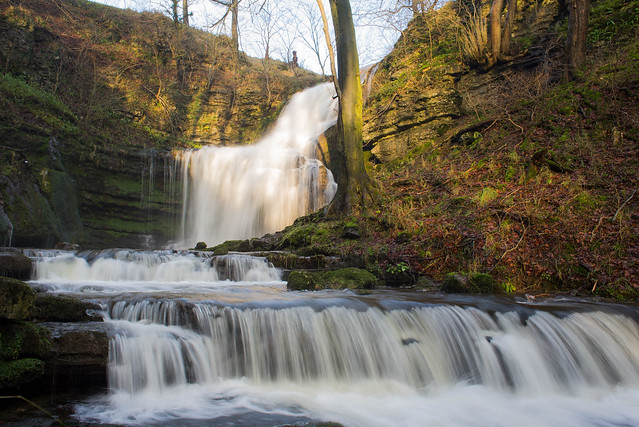
I'm not one for disaster photography. Today the sun came out for a moment, so I cycled up to the local waterfall, Scaleber Force, which was in great form.

Scalebar-1

I suppose I missed the best one - apparently, for the first time evs, the waterfall has started flowing over Malham Cove. That's just a few miles away from Scaleber, on the other side of the watershed.

Meanwhile, James is practising his lime mortaring on some of the places where leaks sprung in our house. We avoided buying one of the newish houses nearby that, although favourably priced, seemed to me to be rather close to the flood plain. Ours is over 100 years old, but that alone doesn't offer much in the way of guarantees for dry toes if we are to have frequent 100 year events. 


--
Posted By Blogger from jules' pics.

Sunday, December 06, 2015

[jules pics] Sand Dunes #2

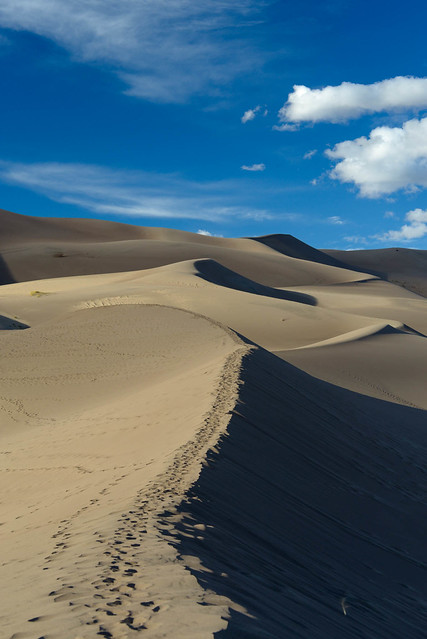
This one has been the front page picture on my iPad ever since...
sanddunes-3

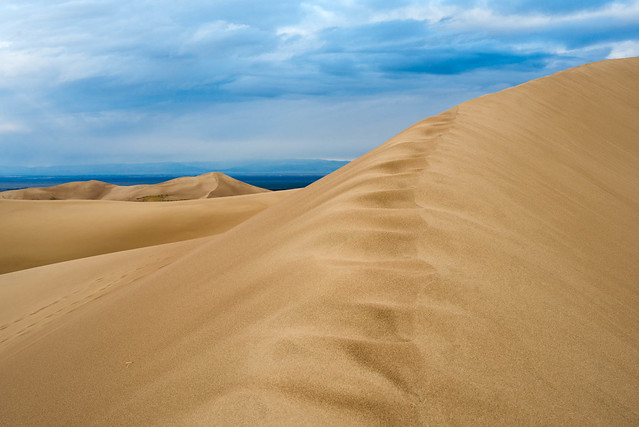
The next morning, James and I climbed the nearest dune peak.
sanddunes-5
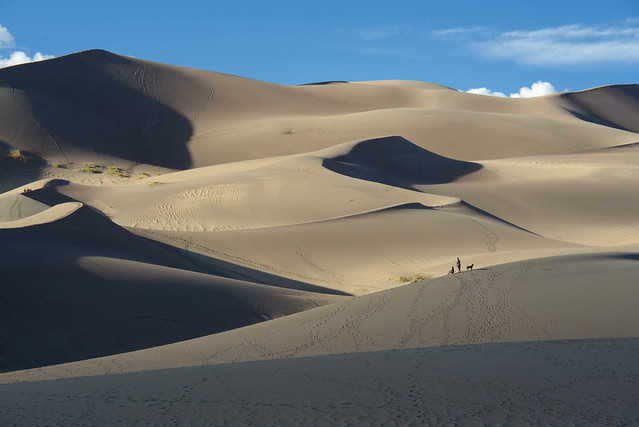
The wind had done a good job of smoothing out all the footprints of the day before, and ours were the first footsteps of the day.

Back to the lodge for a traditional US-stylee breakfast (pancakes etc), and we were back in Boulder that afternoon.

--
Posted By Blogger from jules' pics.

Wednesday, December 02, 2015

Trivial pursuits

So for some reason I got invited to participate in the latest Bray and von Storch survey of climate scientists, having not (IIRC) been asked previously. I barely got started on the meat of it before giving up. Screeds of hopelessly vague multi-choice questions with no context, like: how well do you think climate models can deal with clouds (answer from "very adequate" to "very inadequate"). Can or do deal with? Adequate for what? I'm not impressed.

More interestingly, I swapped a couple of emails with the author of this article over the past couple of weeks while he was writing it. Seems that I didn't say anything quotable enough to get quoted in it, but it looks pretty good to me.

Edit: Oops, first time round I was focussing on the quotable quotes to see if I disagreed with them. On a more careful re-read the author seems to think the last glacial maximum was only 1C colder than the present. No, it was 4C colder (than pre-industrial, ie 5C colder than now).

Sunday, November 29, 2015

[jules pics] Sand Dunes

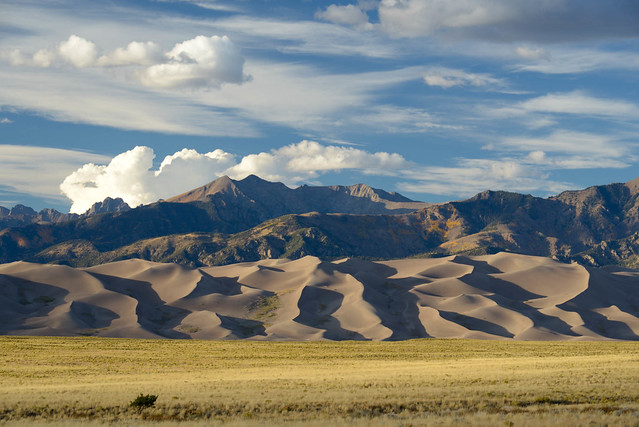
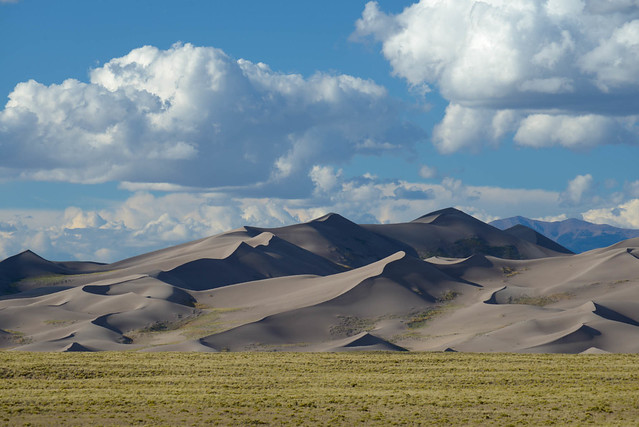
Last stop on our tour was somewhere we have managed to not visit on several occasions, due to it being a bit out of the way: Great Sand Dunes National Park. We arrived in the afternoon and stayed at the nearby lodge, which was excellent with lovely views of the dunes.


sanddunes-4

The existence of the dunes is very interesting; a source of sand in the hills, plus wind blowing and water flowing in the right directions. One might wonder why there are not more dunes about, but these seem to be the only ones in the vicinity, apart, of course, from the ancient ones like those we saw at Canyonlands.
sanddunes-1

It was fairly quiet and there was no evening meal available at the lodge, but the rooms had microwave cookers, so we had shopped in a supermarket along the way. Before dinner, we went to have a closer look at the dunes.
sanddunes-2

--
Posted By Blogger to jules' pics.

Tuesday, November 24, 2015

The Muse

Just like those artsy fartsy "creatives", for scientists to write, they also need to find their muse mews. James seems to have found his. This one is an excellent sort of a muse, being far more practical than the elusive lady that the creatives chase - it not only pins him down, but it also provides warmth, and furriness.


Wednesday, November 11, 2015

[jules pics] Civilisation

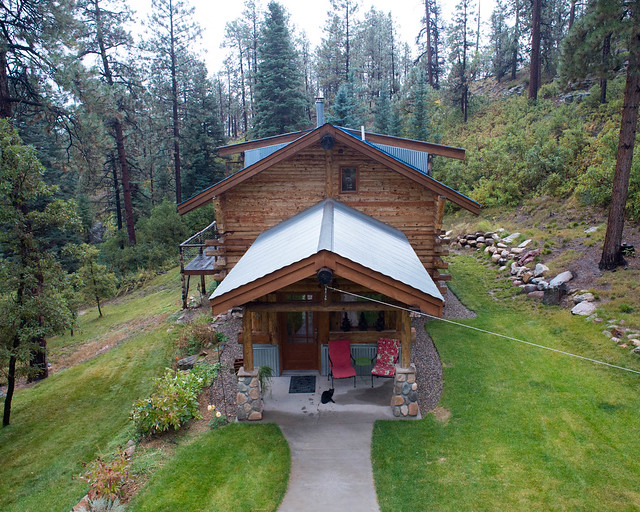
After Hovenweep, we crossed over into Colorado and headed up a dirt road out of Durango. There in a patch of trees live two people I'd never met: the sister of a friend of mine from Japan and her husband. In earlier posts I might accidentally have been a bit impolite about some Americans. Actually I think they are a more evolved life form.  My friend, Audrey, had often times told me of her sister (Wendy) in Durango and suggested we visit. Being a straightforward kind of a person, I can't tell if these kind of invitations are serious, but Audrey is a lovely person, so I decided to take her up on the offer of her sister's hospitality! And they were indeed amazingly generous. It was actually my friends's sister's husband (Rob) who did more of the hospitality as he was not working that day. The couple had built their house 20 odd years ago using the proper American method of buying a patch of forest and reconfiguring the trees therein into a log cabin.

Thus:
1 over cabin dcabin-1

It only took them 3 years. Wow. People like this in the UK get television programmes done about them! After a comfortable night in the cabin, Rob took us on a delightful tour of Durango. 


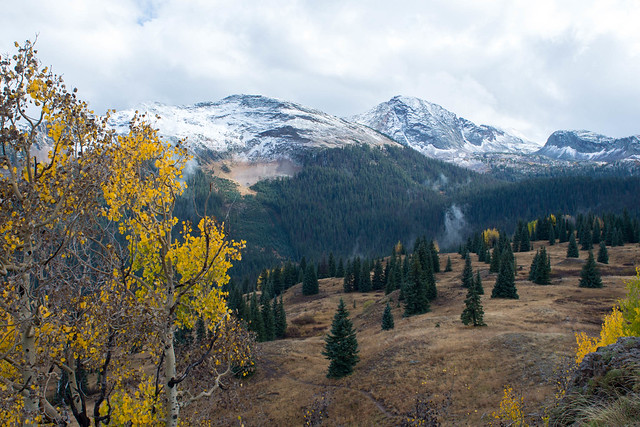
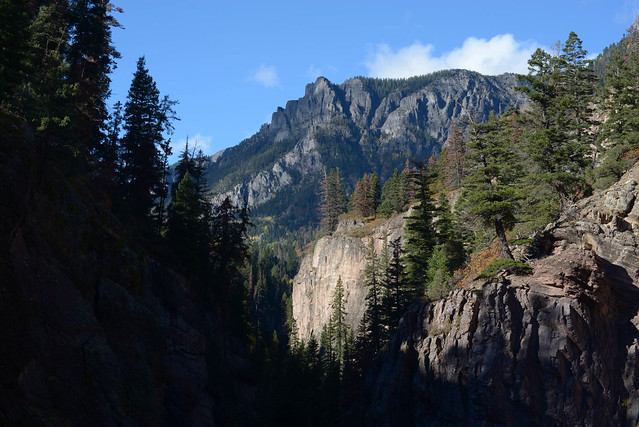
Next stop was the million dollar highway and Ouray. Ouray is another very cute town. But instead of more pix of buildings, here are some nice mountains. 

Continental Divide


Ouray

The first is the high point of the highway before Ouray (the "conninennal divide"), and the second is the view from the top of the Box Canyon Falls in Ouray.

--
Posted By Blogger to jules' pics at 11/11/2015 01:50:00 PM

Monday, November 09, 2015

New publication model for EGU journals

There's been longstanding debate over the way in which manuscripts are handled by the EGU/Copernicus journals. The current system is that publication fees are charged for submitted manuscripts, which are professionally typeset (hence incurring significant costs) and appear in an on-line “Discussion Journal” like CPD, GMDD etc where they remain as part of the public record (with DOI etc) irrespective of whether a final peer-reviewed paper appears or not in the non-D journal. There are several drawbacks with this approach, though its originators and advocates have always argued that the benefits outweigh these.

Well, it's all changing now anyway. From January, submitted manuscripts will not be professionally typeset, the Discussion journal will cease to exist (though the submitted manuscripts will still be public and citeable), and paper charges will only be applied after the paper has been through peer-review. It will be interesting to see how this affects the journals, and whether for better or worse. As for me, I'm pretty ambivalent about it. Paying charges in advance was always a bit awkward and puts editors in a difficult position when rejecting papers (at GMD, the unofficial policy was to offer a hefty discount on fees for their next submission). On the other hand, perhaps it does dissuade a certain amount of dross - though it apparently didn't help with this nonsense. Anyway, the new system will be much closer to the standard model for journal publication, while retaining the special feature that not only the final manuscript, but also the review process, is on-line and open to all.