Wednesday, February 27, 2013

[jules' pics] Cash Society

The Japanese economy runs on the belief that all the futons of all the octogenarians are stuffed with 10,000¥ bills. This belief enables us to believe that the country is not, in fact, bankrupt. If the exchange rates are anything to go by, we've conned the rest of the world too. However, there is no doubt that Japan is a cash-based society. We always warn our visitors of this, but there is still sometimes the odd one who arrives with just one of those useless little plastic things they call "credit cards"***.
We have 6 scientists from foreign visiting us in a couple of weeks. Of course I have already warned them about the cash thing, so this is just an illustration. Yesterday afternoon I got a dental implant. I took James along. For support? Perhaps partly, but mostly he was there to carry the cash. I really didn't want the double stress of being operated on and also looking after the equivalent of 3000 USD.
We do have little plastic cards in Japan. Many of them. In fact all my hospital details are on one. In order to pay, I slide the little plastic card into the machine, and then the machine asks for the cash:
Cash please!
It was a lot of fun feeding in all the notes. So to be fair there is a button on that screen labelled "credit" and another labelled "debit", so there was probably some way of paying by bank transfer, or at least of paying in installments. However, I couldn't see how one could use an actual credit card.
And here's Dr Ueno-san, looking forward to the money filtering down to him.
Ueno-san
The flip-side is that he has to work in Tsurumi, which is one of those weird suburbs, that doesn't even have a Starbucks. I suppose it can't be all bad, with so many bicycles.
Tsurumi
Tsurumi
***Credit cards are not actually entirely useless in Japan. They can often be used to pay for large items in big stores, but it is usually cheaper to use cash. Most hotel chains probably take them too. However, they are generally not accepted at smaller places, and can only be used to obtain cash at the Post Office ATMs, so they are definitely not the tool of convenience that they are in most other 1st world countries.

--
Posted By Blogger to jules' pics at 2/27/2013 04:13:00 PM

Friday, February 22, 2013

Yet more on uniform priors and the misinterpretation of p-values

From this (which is very relevant to climate science, where misinterpretation of p-values is entirely routine):
The default conclusion from a noninformative prior analysis will almost invariably put too much probability on extreme values. A vague prior distribution assigns much of its probability on values that are never going to be plausible, and this disturbs the posterior probabilities more than we tend to expect—something that we probably do not think about enough in our routine applications of standard statistical methods.
Of course, it's not something that will be news to readers of this blog...but it's a shame that this elite group seems to not include IPCC authors and their colleagues...

Thursday, February 21, 2013

[jules' pics] Half-biking.

BEB
If God had meant us to run, He wouldn't have given us these brilliant minds that could invent wheels. We still need to work on the gears, however. Bike was singlespeed not long into the trip home (snow had melted and turned to mud).
snowy Kamakura
snowy trees
Have discovered that I can MTB to work in about the same time it takes James to run. So for the first time yesterday he ran both to and from work, while I rode my half-bike. Of course we have mountain tandemmed it many times, but I think James might have got a bit bored of carrying quite so much bicycle, and a bit too keen on running! I always wanted to attempt to steer the (rather technical) course. Mountain half-biking is excellent all-body exercise, whereas the tandem stoker doesn't really use the upper half of their body. My arms are tired today!

--
Posted By Blogger to jules' pics at 2/21/2013 10:36:00 AM

Wednesday, February 20, 2013

Snap

My silly answer to David Benson's comment got me checking older photos...

And this from last Sunday:

Motomachi cars

looks strikingly similar to this from exactly a year ago:

vintage cars on Motomachi 

It's not just the same car type, but the number plate is identical too! So I don't know what that means - either the plate was swapped over, or the bodywork has been switched or resprayed. I'm not sure what is least likely. But either way, there may not be quite as many different people independently parking odd cars in the same place on Sunday morning. And it would help to explain why they don't all turn up on the same day.

Tuesday, February 19, 2013

[jules' pics] Starbucks parking # !%&'

I still don't understand the Motomachi Starbucks parking hobby, but cars I had not seen before appeared on Sunday.
I thought this one was quite impressive...
Motomachi cars
Motomachi cars
Until this monster drove up.
Motomachi cars
Wot an amazing colour...
Motomachi cars
...not that the camera is necessarily accurate in hue (which is all in the mind anyway) but the intensity and matte sheen seem truthy.
A weird olde-stylee station wagon appeared later too, but I didn't take its portrait. It was kind of a yucky pale green... and as we all know, colour is the most important thing.

--
Posted By Blogger to jules' pics at 2/19/2013 02:11:00 PM

Monday, February 18, 2013

[jules' pics] Engakuji

We have visitors next month, and I seem to have promised them flowers. So we took a trip to Engakuji (in Kita-Kamakura) to evaluate the ume blossom status.
ume
One or two ume trees are in full bloom. The little birds looked to be drinking the nectar. Usually I find them impossible to photograph, but this time they were so intent on their breakfast that I could get quite close.
bird and ume
However, most of the trees still only have tiny buds, and a few are half out...
ume
The dragons are looking quite hungry...
Engagkuji dragon
All in all it is looking quite promising.
Engagkuji


--
Posted By Blogger to jules' pics at 2/18/2013 10:48:00 AM

Sunday, February 17, 2013

[jules' pics] Water Jump

During an intermission in the half-marathon, I turned my camera 180 degrees and captured this flying water person. The leap was followed by an undignified splash, the boat stopped, and "DaiJoBu, DaiJoBu?" ("Are you OK? Are you OK?"), could be heard over the loud hailer. This is what you shout at someone who looks dead but might just be pretending. The boat tracked back and pulled them out. They seemed to be not very dead after all. I was quite relieved not to have captured someone's last living moment.
Akabane Half Marathon - water skiier
P.S. Click on the image in flickr to see a larger version, which is much clearer.

--
Posted By Blogger to jules' pics at 2/17/2013 08:39:00 PM

The inevitable failure of attribution

I don't know if this has been clearly discussed elsewhere, but the recent publication of a couple of papers on the topic gives me a good excuse to talk about it. The first is Gillett et al, in GRL a little while ago, and there's a new paper by Gareth Jones et al in press at JGR. Both appear to perform fairly conventional D&A analyses on CMIP5 models. I've been fairly critical of the conventional D&A approach in the past, primarily on the grounds that the null hypothesis of no anthropogenic influence is always false a priori (and therefore a failure to detect an anthropogenic influence is always a matter of insufficient data). These recent papers point to another, arguably more terminal, problem. Attribution will inevitably fail as the anthropogenic effect increases!

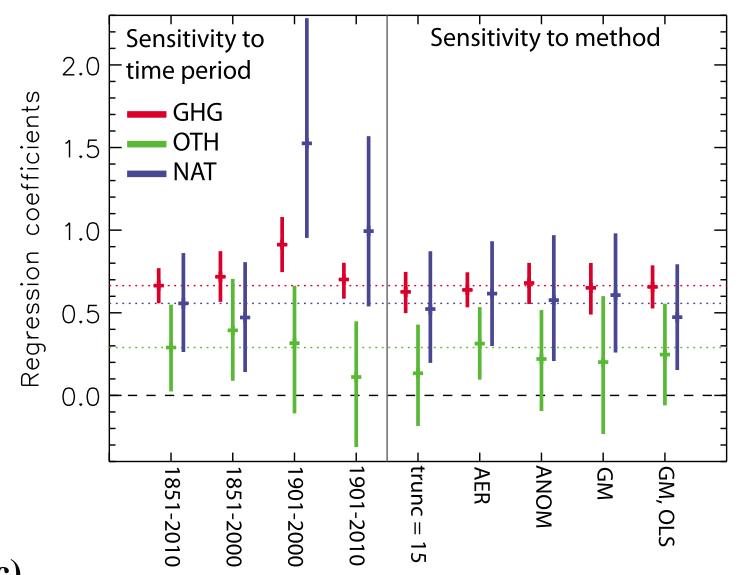
Gillett et al present their results primarily in terms of a better constrained estimate of the transient response. What they don't point out is that they cannot actually attribute the warming to anthropogenic forcing. As conventionally portrayed (eg by the IPCC here), attribution requires that the observed changes are consistent with the modelled estimate. However, the Gillett et al estimate of the scaling factor on the anthropogenic (GHG) component is about 0.7, with a confidence interval that clearly excludes 1. The figure below is the relevant one from their paper, and the critical point to note is that the left-most red coloured bar (which represents their main analysis) does not reach 1 on the y-axis. In fact the only way they can get a result which is consistent with the model is to limit their analysis to 100y of data. So, according to the standard definition their analysis simply cannot attribute the recent warming to GHGs.


Jones et al analyse a larger set of models, and for about half of them, the confidence interval on the estimated scaling factor includes 1. Don't blame me for the horrible picture below which is all that is available in their pre-production proof (hopefully the final version will be readable). Again, the central issue is whether the red bars on the figure include the value y=1. By my count, 9 of them do but 7 of them don't. (5 of the ones that do include 1, also include zero in the ranges of both G and OA, indicating a failure to detect an anthropogenic inflence at all. This voids any attempt at attribution a priori. However, I'm not so interested in that here.)


A moment's thought should confirm that failure to "attribute" in this sense will be an inevitable consequence of gathering a sufficiently long and precise time series of data. The actual value of the scaling factor - ie the ratio of real to modelled forced response - is never going to be precisely 1, for any model, any more than the actual value of the forced response is zero. All such hypotheses based on point estimates are inevitably false, and a failure to reject them only ever meant we didn't have enough data. But now it is increasingly the case that we do have enough data to reject many of the models. And this problem will only get worse as the data will surely keep pouring in at a rate greater than model improvement can keep up.

It will be interesting to see how the D&A community addresses this problem. Atribution of the observed changes to GHG and other influences was touted as a major step forward when it was first achieved, so it would surely be rather embarassing to lose the ability to do this. It looks a bit like they are trying to just ignore it for now, but that can't really be tenable as a long-term strategy.

Monday, February 11, 2013

In-visa-ble man (and woman)

Jules and I are supposed to be en route for the PAGES Open Science Meeting in Goa, but due to the situation turning out not necessarily to our advantage, we aren't. So I suppose I might as well write this blog post instead.

We knew from ages back that we needed visas for India, even for a conference visit, but we didn't expect it would be a particularly onerous or lengthy procedure. Everywhere else we've ever gone, conference trips are considered as innocuous as tourism, which means they have been covered under the tourist visa waiver schemes that developed countries commonly have. India, however, doesn't seem to have this sort of arrangement. So back in November, the organisers sent us some official documents that they said we needed for visa applications. But we had trips to San Francisco and then Hawaii to come, and the web site for visa applications suggested a time scale of about 8 days.

So, we came back from Hawaii, with the usual backlog of stuff to catch up on. I had a meeting in Tokyo on that Friday morning, and was going to go in to the visa application centre on the afternoon...but I checked on Thursday night and the web site said: "Manual Visa Application System is ceased from January 2013. Hereby, all the Applicants should apply for Indian Visa using Online Visa Application System only." Clicking through took me to a big form full of lots of tedious questions. So I left it for the weekend.

After struggling and failing to find out over the weekend how to actually apply on-line, we decided that we had better just go in on the Monday and wave the forms at them. It turned out that this is the correct course of action - the Indian interpretation of "Online Visa Application System" is actually "fill in a form on a web page, then print it out and take it to Tokyo".

Then came the real bombshell: "Sorry Sir, the visa process now takes 2 or 3 weeks, we cannot guarantee it will be ready in time for your trip. But we'll take the fat application fee anyway". They didn't actually say the second sentence.

So, the Thursday before our Sunday night flight rolls up, and I phoned up to see if there was any chance of the visa being ready by the next - last - day. "Sorry Sir, we are just an outsourcing company, we have conveyed the urgent request to the Embassy, but do not know anything about your visa. You must check the website, it will tell you when your visa is ready". Friday came and went, and there was still no news, so at the end of the day, we cancelled everything. After getting home on Friday night, I checked the website again...and it said our visas were now ready and awaiting collection. But with the office shut until Tuesday, there was no way to get our passports back.

I was slightly relieved to see that Gavin tweeted yesterday that he had also failed to get his visa - not that I wish anyone the same frustrating waste of time and money on anyone, but it's a bit less embarrassing than if we'd been the only ones. But we only had a grand total of 14 working days between jules returning from Hawaii, and our departure to India, so although we might possibly have got our visas if we'd really be on the ball from the moment she arrived home with 10h of jetlag, even then it could not have been guaranteed. And there is no way we could have known that the visa application might take 3 weeks, as even now the only time scale mentioned on the web site is still the old estimate of 8 days (albeit with a footnote to say it is wrong). "All the applicants are requested to make their schedule to visit India accordingly." "When hell freezes over" sounds like a good time right now.

[jules' pics] Akabane half-marathon

As James said, I wasn't really trying. I had sufficient energy to look like I was really running as I crossed the finish line!
Akabane Half Marathon - 10K
I've always been quite aggressive in cycling and rowing competitions, but I haven't got the heart to try to beat all the wee Japanese women just doing their cutie best. I tend to go with them a little and then let them pass just so they can feel good. Of course if I see a child or another whitey then I can't help but start racing, but I saw none of either in this race, so had a pretty easy time. I stuffed loads of men, so what was the point trying to be faster? Some of those men shown here, rolling up some time after I'd already changed.
Akabane Half Marathon
The bonus was that I had lots of energy left over for photographing the half-marathon.
Fingers on Garmins...
Akabane Half Marathon
Those at the front without numbers, but names instead, are special invited runners.
Go!
Akabane Half Marathon
There were about 5000 runners, and things quickly got less serious.
Akabane Half Marathon
I'm not quite sure why some people were bothering. After I decided to move up the course for a different view, I found I was walking almost as fast as some of the runners. But it did make me think I too could complete a half marathon! The course had a small number of small hills. We both found it curious that the other runners didn't run down hill but rather just maintained their pace. I passed many on each of the down hills. Is this not running on hills a secret runners' trick, or had these people just never seen a hill before?
Akabane Half Marathon
Beautiful scenery all around ... not.
Akabane Half Marathon
I was in position up the course by the time the leaders returned (around 17km). Luckily the correct people (note no numbers on chest) were in front, but they are kind of boring to photograph, zooming along like well oiled machines. Cyclists legs are so much sexier... sigh...
Akabane Half Marathon
The not-quite-leaders were more fun as they were in significantly more pain.
Akabane Half Marathon
Further back, this group still seemed to be running quite powerfully.
Akabane Half Marathon
Then came the funny body shapes, those in fancy dress, and finally the women and children came jogging passed. Here's enormous James being beaten by a tiny little woman. At this point, he'd just helped her through the strong headwind section. What a kind man! Seems he has the same problem as me with racing the tiny women. She beat him by about half a minute in the end.
Akabane Half Marathon
This was as good as the views got. Was it really worth getting out of bed for?
Akabane Half Marathon
Not everyone just pushed buttons on their Garmin as they cross the line.
Akabane Half Marathon
I think fewer die after the half-marathon than the marathon. Mostly the finishers looked quite chipper.
Akabane Half Marathon


--
Posted By Blogger to jules' pics at 2/11/2013 08:52:00 PM