Friday, March 31, 2006

Lookalikes

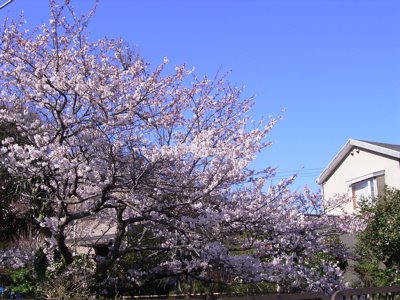
Just got back from my trip yesterday. I noticed on touchdown that the weather was surprisingly similar in the UK and Japan. Here are two pictures, one taken in the North Wet of England, and one snapped on my commute to work this morning. Can anyone identify which is which?


Land of the rising sun
Land of the falling rain
There was supposed to be a solar eclipse on Wednesday morning across the UK, but how could anyone tell?

RealClimate article on climate sensitivity

There's a nicely-written puff piece by Gavin about our recent GRL paper here on RealClimate. I've added a couple of brief comments here and here. Virtually none of the readers' comments actually touched on the content of our paper...

Saturday, March 25, 2006

Every bloody train!

I'm on a brief trip to the UK now. At the Japanese end, all the transport went as smoothly as ever - bus, train (with change from local to express) and plane.

Within 3 hours of landing in the UK, we'd used 3 different train lines, and had delays on each one of them! Firstly the Heathrow Express was 10 minutes late (on a 15 minute journey), despite being perhaps the most expensive train journey in the world (more fool us for not just getting the tube - but we were hoping for a quick journey...). Then on the tube, the Circle line was delayed, so we were sent on a detour involving another change at which some "helpful" staff sent us back onto the Circle line, apparently unaware of the delay in the first place. Back onto the main lines at at Euston, there was a row of machines for ticket purchases, which seeems great until you try to buy a ticket and are faced with the helpful message "some restrictions may apply" on all the reasonably-priced options. We did manage to find a human face and found out that the cheapest option was to buy a weekend return (despite it being a Friday afternoon, and even though the return portion was unusable for us - this was still 24 quid cheaper than a standard single). Then when travelling up to Lancaster, the train sat in a field for just long enough to turn our 15 minute connection into a 2 minute dash across Preston station.

In the end, we were only about half an hour later than we would have been if everything had run as well it does in Japan. So no great disaster overall. And there are sometimes delays in Japan too - due to such things as suicides on the line, earthquakes or typhoons. But here in the UK it seems to be a way of life...I'm looking forward to getting back home!

Thursday, March 23, 2006

Comment on Frame et al

As I hinted recently, I've got a few things to say about Frame et al: "Constraining climate forecasts: The role of prior assumptions", GRL, 32(L09702) (F05). In fact, jules and I submitted them as a comment to GRL a couple of weeks ago.

I'll start off with the bits I like: F05 give a nice demonstration of how the choice of prior can have a significant influence on the resulting pdf in a probabilistic estimation, especially when the observational evidence is quite weak. Furthermore, markedly different results can be generated by different, but apparently natural and plausible, ways of describing initial ignorance. Therefore the same evidence could be used to draw quite different conclusions due to what are ultimately fairly arbitrary choices. It's obviously an important point that doesn't appear to have been adequately considered in at least some previous work.

If they'd stopped there, I'd have had nothing to complain about. But now on to the bits I don't like so much. Firstly, they present what they see as the solution to this problem - they assert that we should choose the prior to be uniform in the variable which we are trying to estimate (ie uniform in climate sensitivity, if we are wishing to estimate this). This, in their words, "resolves" the "arbitrariness" and allows them to generate what they describe as "objectively determined" estimates. "Objective" is a dangerous word to use here, as the probability cannot be objective in the sense of a frequentist probability - what they presumably mean is merely that they are providing an automated rule that removes this element of choice from the procedure (or perhaps, imposing their own subjective judgement in place of anyone else's). But that's not the biggest problem I see in their suggestion. Where their method really falls down is that it generates results which are not self-consistent. As we demonstrate in our comment, their method will generate the pair of results P(X>3)=2.3% and P(X4>34)=7.8% from a single observation of X=2+-0.5. Under any standard definition of Bayesian probability, P must be a function, which (again by definition) means it must be single-valued. But X > 3 and X4 > 34 are precisely the same proposition (there's no sleight-of-hand with negative values here: X is positive definite, and I could equally have used X3 or X5). Therefore their P cannot be a probability at all!

There are some generalisations of probability (Dempster-Schafer theory) in which probabilities are defined as taking a range of values. Elmar Kriegler is the only person I know who's gone any distance down this path within climate science. Arguably, this provides a better framework in situations of deep uncertainty, but handling these issues correctly is far from trivial (note that a uniform prior in X does not actually represent a state of true "ignorance", but rather the specific belief that 10 < X < 20 is ten times as likely as 2.5< X < 3.5, for example). It is not at all clear to us that F05 have provided adequate theoretical justification and underpinnings for what is in fact a rather drastic challenge to the standard view of Bayesian probability, and they certainly haven't (IMO) drawn sufficient attention to the radical implications of their work.

The other complaint we have about their paper is in their description of the sort of problems that we are all attempting to answer. They say:
Unless they are warned otherwise, users will expect and answer to the question "what does this study tell me about X, given no knowledge of X before the study was performed?"
(and they use "no knowledge" to justify their choice of a uniform prior). In context, this could reasonably be re-written as (A) "what would our estimate of climate sensitivity be, if we had no data and knowledge other than that directly considered by this study?"

However, it seems clear to us that what users really want to know is (B) "what is our estimate of climate sensitivity, using all of our data and knowledge?"

The answer to question A will necessarily have greater uncertainty than the answer to question B. If someone wants to generate an estimate of climate sensitivity, they should use all of the data, either by explicitly considering it, or by the use of a prior which encapsulates (as accurately as possible) the information which the study doesn't directly look at! This is precisely the issue that our recent paperaddresses, so perhaps it is a bit harsh to pick on F05 in this respect (rather than the numerous other papers that have apparently mixed up the two questions in a similar way). On the other hand, these guys are specifically presenting a theoretical analysis of probabilistic estimation, together with recommendations as to how we should all go about it in future (rather than just having a go at producing an estimate themselves), so it's surely more important that they get it right. We certainly don't think that their opinions should be accepted by default, without some meaningful debate over the issues.

Inevitably, given the space constraints of a 2 page comment, it is hard to get the points across clearly without running the risk of appearing overly hostile. That's life, and I'm sure they have thick enough skins to cope. Indeed, depending how they reply, our comment might end up in the bin anyway - unlike most papers, where I only have to convince some neutral referees and can therefore be pretty confident of publication, in this instance there is (at least potentially) an opponent who will try their best to point out weaknesses in our case.

Both these comments, and the contents of our recent paper, are summarised on our poster for the EGU in a couple of weeks. It will be interesting to see how they go down. Unfortunately I'll not be there, so jules will have to face the angry horde by herself :-)

Wednesday, March 22, 2006

Yes I *DO* pay Road Tax

It's a commonly-heard complaint in the UK that "cyclists don't pay Road Tax". This is apparently considered justification for all manner of dangerous, aggressive and incompetent behaviour on the part of car drivers - you don't pay tax, so it's ok to drive into you. There are numerous reasons why this argument is invalid a priori, and of course the sociopathic conclusion doesn't follow from the premise anyway, but I can't be bothered going into that in more detail here (see here and here for some of the arguments).

What I can be bothered blogging about is the fact that the Chancellor the Exchequer (and Prime Minister in waiting) has just introduced a new banded system of Vehicle Excise Duty ("Road Tax" in common parlance) which specifies a nil rate for vehicles with sufficiently low emissions. There aren't many cars in the bottom band ("A"), but a bicycle would certainly slot right in there!

I expect an innovative clothing supplier or cycling activist group to start offering t-shirts for sale with a "Band A Vehicle" logo :-)

[Of course the pedants may still point out that technically, we still don't pay this tax on bicycles, they are exempt. But in practical terms, it's good enough for me (um...or would be, if I was in the UK).]

Tuesday, March 21, 2006

Simulator 2 news

Looks like good progress is being made on the new technologies that are expected to bring 10 petaflop computing by the year 2010. The Earth Simulator, deposed a year or two ago from the top of the Top 500 list, comes in around 40 teraflops, which means that the upcoming machine will be faster by a factor of 250. It will be interesting to see if the new machine grabs the top spot as comprehensively as the ES did - when the ES was first switched on, it was 5 times faster than its nearest rival, and it held on to the top spot for more than 2 years.

Interesting article on immigration in Japan

In the JT today:
Sakanaka recently poked his head above the bureaucratic barricades, suggesting that Japan allow in 20 million immigrants over the next half century.
The author of that opinion is not some radical revolutionary, but the ex-head of the Tokyo Immigration Bureau. And there's lots more:
"It's almost taboo to raise the issue of mass immigration here," he says.

"Japan has no experience of this, only of sending people abroad. Modern Japan almost totally shuts out foreigners and the only people who debate the issue are specialists. Nobody is even researching it."
Meanwhile, the politicians talk up the dangers of terrorism and re-introduce policies to fingerprint all foreigners (and keep the data for 80 years)...

Saturday, March 18, 2006

Tallahassee trip

I've just been to Tallahassee for a few days. I've already written about the workshop that motivated the trip. Usually I try to fit a bit of a holiday around long-distance conference trips, but a combination of Japanes rules, and the fact that the organisers were paying, made it a bit harder than usual this time, and I had not made any plans before I flew. In fact, I'm embarassed to say I didn't even know where Tallahassee was before I landed there :-) Nevertheless, I still managed to see a little bit more than the inside of a lecture room.

Tallahassee seemed a very pleasant town, at least in March (I don't think summer can be much fun). On the short walk from the hotel to FSU,


I wandered past several real live frat houses - yes, they really exist outside of Animal House!


FSU has a green and pleasant campus, with lots of oaks which all had beards of Spanish Moss dangling off. Wisteria and dogwood (pictured) were flowering, along with azaleas and rhododendrons.

Lunches were provided on-site, but in the evenings I managed to sample a few pints of the surprisingly good Blue Moon beer and some pleasant enough but not exceptional cooking at "Andrews".

The meeting ended at lunchtime on the Wednesday, and some people weren't flying until the evening (I had a whole extra night), so a group of us drove out to Wakulla Springs for the afternoon. This is a large deep spring in a limestone region, a little like the Fontaine de Vaucluse except with a much bigger, flatter, river. And alligators. Lots of alligators.


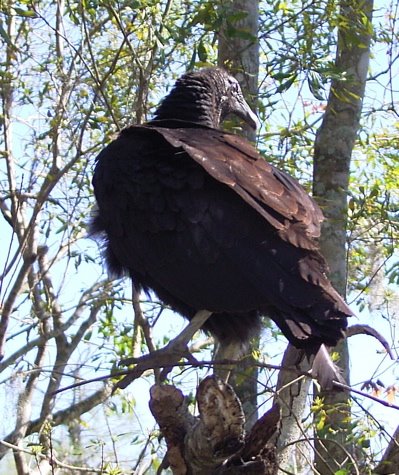
Last time I went to Florida I didn't see any, and it's the one question people ask, so it's nice to have encountered them outside zoos (not that they looked different, of course). There were ospreys and vultures and lots of other birds, familiar and unfamiliar.


There are supposed to be fossilised mastodon bones 150m down at the bottom, but the water was a bit too dark to see that far.

The travelling was uneventful, and wasn't even too painful, considering Florida is about as far away as it's possible to get. In fact some people coming all the way from Colorado took longer than I did, spending a night in a hotel lobby in Memphis with there apparently not being a free bed in the whole city! I spent the time mostly reading the amazing "Number 9 dream", a Christmas present from my sister which I'd been saving up for this trip (I think she read it on her trip to visit us last year). Also, I wrote this (but couldn't actually post it).

Wednesday, March 15, 2006

Florida

I suppose I should show off by blogging live from this Workshop on Predictability, observations and uncertainty in geosciences using my Zaurus via wifi. I haven't had much time over the last couple of days as it's been back-to-back interesting talks without any boring sessions.

It's been great to get back re-acquainted with the bleeding edge of numerical weather prediction (NWP). This is really where it's at in prediction science IMO - these guys have to make forecasts twice a day and mistakes stick out embarassingly. There is no making up stuff and hiding behind the plausible deniability of "our model suggests..." Climate scientists who think there is nothing to learn from this field are really missing out.

The more eminent speakers include (in speaking order) Lorenz, Le Dimet, Kalnay, Krishnamurti, Toth, Anderson. Some perhaps are merely brilliant scientists, several are legends. Exalted company indeed. I understand that the talks will shortly be made available from the website for those who are interested. My talk seemed to go down ok, but I'm not sure that we are quite close enough to the NWP problems to be giving something back to this community yet. We are working on it!

The final session is thinning out, with people drifting off home. I've come away with at least 2 copper-bottomed ideas for future work which will substantially advance on our existing methods. That ceraintly makes it a success in my book...now all I need is a few more hours in the day to work on them.

Saturday, March 11, 2006

Sedimentary, my dear Watson

Had a visit from Andy Ridgwell and his postdoc Jenny Brauch last week. They weren't visiting me, but rather jules and the other paleoclimatologists around here. Andy is doing biogeochemical and sedimentary things with the GENIE model, and our ensemble Kalman Filter is proving to be a very powerful model tuning tool. I went along to some seminars to learn a little...

One thing that fossil fuel combustion will mean is a lot more CO2 disolved in the ocean, and this leads to less calcium carbonate (CaCO3) deposition in sediments (and even dissolution of what is already deposited in the upper sediment layers). Evidence of this can be seen in the past (eg PETM), when there is also a spike in carbon isotopes suggesting a big release of some old carbon (potentially methane clathrates). Andy's been simulating what might have happened, using a biogeochemical and sediment model embedded in the atmosphere/ocean system.

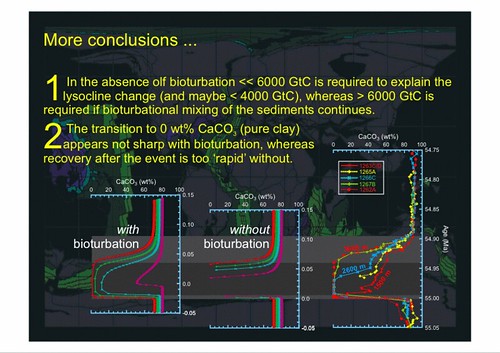
He's got some really impressive results in the pipeline (being written up), and here is a sneak preview:


The RH lines are plots of carbonate concentration from actual cores, and the two LH plots are simulations under slightly different conditions. One interesting detail in the far LH plot is that the spike appears to start at a different time in the purple core. This is actually because the carbonate is eroded down further in the other cores, eating back in time and erasing the sediment record. It does make me wonder at the precision of core dating, since generally spikes in different cores are assumed to be simultaneous and so are lined up (of course the scientists concerned are well aware of the problems). This is the sort of thing that can only really be investigated by "forward modelling of proxies" (increasingly fashionable these days) in which the proxy creation is embedded into the model itself, rather than the old traditional approach of inverting the proxy into climate variables, and then comparing these variables to your model.

In the next few centuries, I suppose we'll erase the past 10-100,000 years of carbonate history. I wonder what the androids alive 50 million years from now will think of it. In terms of climate change it is somewhat helpful, as the carbonate ions neutralise the aqueous CO2, increasing the ocean's capacity to dissolve CO2 (somewhat counterintuitive to numpties like me that the carbonate erosion helps things, but even though the total load of dissolved carbon increases, the CO2 and CO3(2-) together with an H20 make two HCO3(-) ions which do not exchange with the atmosphere). It's not a massive effect, though, and the bugs that try to make CaCO3 might not like the increased acidity much.


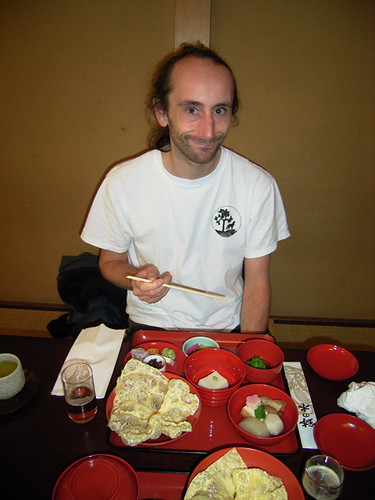
It wasn't all work and no fun - as well as a trip to Tokyo (which we had to do anyway, for this), we showed them round Kamakura. Andy is a vegetarian, and Japan isn't the easiest place to find good vegetarian food. So he was happy to be taken to the shojin-ryouri restaurant just outside Kenchoji temple. I'm not sure that the beer is strictly Buddhist, but neither are we :-)

(T-side also does a lot of veggie food - we went there for dinner)